If you have been searching for how to stop premature ejaculation, you are probably looking for something more useful than generic reassurance. You want practical answers. You want to understand why it happens, whether it is normal, and what you can actually do to improve control. Most of all, you want to feel less frustrated and more confident during intimacy.
That is understandable. Premature ejaculation can affect much more than timing. It can shape self-esteem, increase performance anxiety, create tension with a partner, and make sex feel like something to “get through” instead of enjoy. It can also become a cycle: the more you worry about ejaculating too fast, the more tense and reactive your body becomes, and the harder it is to slow down.
The good news is that premature ejaculation is common, treatable, and often responsive to a combination of better awareness, behavioral techniques, communication, and medical support when needed. In modern sexual wellness and men’s intimate health, the goal is not perfection. It is better control, less pressure, and a more satisfying experience for both partners.
Before getting into the 12 strategies, it helps to define the issue clearly. Premature ejaculation is usually not just “finishing faster than you wish” once in a while. Most experts describe it as a pattern of ejaculating very quickly, often within about one to three minutes of penetration, along with feeling unable to delay it and experiencing real frustration or distress because of it. That matters because occasional fast ejaculation is normal. A repeated pattern that affects confidence or relationships is where management becomes worth exploring.
Why It Happens in the First Place
One of the biggest misconceptions in sexual medicine is that premature ejaculation happens only because someone is “too excited.” Excitement can play a role, especially in new relationships or after time without sex, but it is rarely the whole story. Premature ejaculation can be influenced by performance anxiety, learned sexual habits, relationship stress, erection worries, oversensitivity, pelvic floor tension, and sometimes underlying health factors.
In men’s intimate wellness and modern sexual health care, providers usually look at premature ejaculation as a pattern rather than a single moment. A person may feel like the problem is happening “out of nowhere,” but there is often a chain behind it. The body becomes more reactive, the mind becomes more vigilant, and sex starts to feel like something that must be controlled perfectly. That pressure alone can make ejaculation happen faster, which then reinforces the fear the next time. Once that cycle begins, it can become surprisingly persistent even when the original trigger was temporary.
This is why the most helpful question is not simply, “Why can’t I last longer?” The better question is, “What is making my body rush, and what is making it harder to settle down?” In sexual wellness care, that shift matters because it turns the issue from a personal flaw into something understandable and treatable.
Performance Anxiety Is More Powerful Than Many Men Realize
Performance anxiety is one of the most common drivers in men’s sexual wellness. When someone is focused on whether they will satisfy a partner, lose control too quickly, or “mess up” the experience, the body usually does not relax. It becomes alert, tense, and highly reactive. That state makes it harder to pace arousal and easier to move quickly toward orgasm.
For some men, the anxiety starts after one or two disappointing experiences. For others, it begins much earlier because sex was always tied to secrecy, time pressure, shame, or fear of being caught. Over time, the brain learns to associate sexual stimulation with urgency. Even when circumstances change, the body may keep running the same old script. In relationship-centered intimacy care, this is an important insight: premature ejaculation is often not about a lack of desire or attraction. It is about how the nervous system has learned to respond under pressure.
Learned Sexual Habits Can Condition the Body
Another major piece of the puzzle is conditioning. In sexual medicine and intimate care, providers often see men whose solo habits unintentionally trained the body for speed. If masturbation developed around rushing, keeping quiet, or finishing as quickly as possible, the nervous system may become efficient at reaching orgasm with very little buildup. That pattern can then carry over into partnered sex.
This does not mean masturbation causes premature ejaculation. It means that repeated habits can shape how the body responds. A fast, goal-driven pattern teaches one kind of response. A slower, more aware pattern teaches another. That is why behavioral retraining is often part of treatment in sexual wellness clinics. The body can learn speed, but it can also learn pacing.
Relationship Stress Can Show Up Physically
Not every cause starts in the body. In intimate wellness, emotional context matters. If there is unresolved tension in the relationship, difficulty communicating, pressure to perform, fear of disappointing a partner, or lingering resentment outside the bedroom, those things can quietly affect sexual response. Some men become hyper-focused on “doing well,” while others feel less relaxed and less present during intimacy. Both reactions can increase arousal instability and reduce control.
This is one reason premature ejaculation is not always an individual issue. Sometimes it is happening inside a couple dynamic that needs more safety, honesty, and collaboration. When sex becomes something a person feels judged on rather than something shared, the experience often gets faster and more stressful instead of more satisfying.
The Overlap With Erectile Concerns
One of the most overlooked explanations in men’s sexual health is the connection between premature ejaculation and erection worries. If someone is anxious about getting or keeping an erection, they may unconsciously rush toward orgasm before firmness changes. In that situation, ejaculation is not only fast. It is also tied to a fear of losing the moment altogether.
This overlap matters because it changes how the issue should be approached. A man may assume he only needs help with ejaculation timing, when in reality he is also dealing with inconsistent erections, circulation-related changes, or mounting anxiety around performance. In sexual medicine, these two concerns often feed each other. The more a person worries about losing an erection, the faster he may finish. The faster he finishes, the more pressure he feels the next time.
That is why a full sexual wellness evaluation can be so useful. It helps determine whether premature ejaculation is standing alone or whether it is part of a bigger pattern involving erection quality, stress, confidence, or physical health.
When “Too Fast” Is Really a Response to Fear
For some men, what looks like poor control is partly a protective response. The body senses uncertainty about firmness, endurance, or sexual performance and moves quickly toward climax. This is not a conscious decision, but it can become a learned response. In regenerative men’s health and intimacy-focused care, treating the fear around sex is often just as important as treating the timing itself.
That is also why embarrassment tends to make things worse. Shame narrows attention and raises tension. Curiosity, by contrast, creates room for real improvement.
Physical Sensitivity and Pelvic Floor Tension Can Play a Role
Physical factors can matter too. Some men appear to have a more sensitive sexual response, meaning arousal rises very quickly once stimulation starts. Others carry chronic muscle tension in the pelvic floor, especially when they are stressed or bracing during sex. In those cases, the issue is not simply mental or emotional. The body is participating in the pattern in a very real way.
Pelvic floor tension is especially important in the intimate medicine space because many men do not realize how much they clench during sex. Tightness in the pelvis, abdomen, glutes, and thighs can create a sense of urgency and make arousal harder to regulate. Instead of moving fluidly through stimulation, the body becomes rigid and compressed, which may make climax happen faster.
This is one reason some sexual wellness treatment plans include breath work, pelvic floor awareness, and exercises focused on coordination rather than constant squeezing. Better control is often linked to better relaxation, not just more effort.
Common Contributors Providers Often Consider
In a sexual health or men’s wellness consultation, providers may look at several overlapping contributors, including:
- performance anxiety and self-monitoring,
- stress, depression, or lack of sleep,
- relationship tension or poor communication,
- learned habits around rapid stimulation,
- concerns about getting or keeping an erection,
- heightened sensitivity or a fast arousal curve,
- pelvic floor tightness or poor muscular coordination, and
- other medical or hormonal issues that may affect sexual response.
What matters is not finding one dramatic explanation every time. What matters is identifying the combination that fits the person’s real experience.
Why It Can Start Later Even If Sex Was Fine Before
Many men assume that if premature ejaculation develops later in life, it must be random. In sexual medicine, that is usually not how providers think about it. Acquired premature ejaculation often has a context. It may begin after a stressful period, changes in a relationship, reduced confidence, erectile inconsistency, health changes, or rising pressure to perform. Sometimes it follows one negative experience that created anxiety, and that anxiety becomes the new problem.
This later-onset pattern can feel especially discouraging because the person knows what it used to feel like to have more control. But it is also useful information. It suggests the body is responding to a change, not that the person has suddenly become incapable of satisfying sex. In sexual wellness care, that means there is usually something concrete to explore and address.
Questions That Help Clarify the Pattern
When providers in intimate wellness and men’s health evaluate premature ejaculation, they often want to know:
- Has this been present since your earliest sexual experiences, or did it start later?
- Does it happen every time, or only in certain situations?
- Are erection changes happening too?
- Has stress, sleep, medication, or relationship tension changed recently?
- Do you feel anxious before sex even begins?
These questions help shift the conversation from frustration to pattern recognition. Once the pattern is clearer, management usually becomes more targeted and more effective.
Why Understanding the Cause Improves Treatment
One reason many men feel stuck is that they search for a single universal fix. But premature ejaculation does not always come from the same place. If anxiety is driving the pattern, relaxation and communication may matter most. If the issue overlaps with erectile concerns, improving erection quality may also improve control. If rapid habits trained the body for speed, slower and more deliberate retraining may be essential. If pelvic tension is part of the picture, learning to release rather than brace can make a meaningful difference.
That is the practical value of understanding why it happens. It points toward the right mix of solutions. In sexual wellness care, this is what builds confidence: not pretending the problem is simple, but recognizing that it usually becomes more manageable once the real contributors are identified.
For some men, it has been present from their earliest sexual experiences. For others, it develops later after years without the problem. That second group often assumes it came out of nowhere, but there is usually something in the background: stress, changing erections, hormonal issues, sleep problems, shifting confidence, or pressure to perform. In sexual wellness care, this is why the question is not only “How do I last longer?” but also “What is driving the pattern?”
Understanding that makes the solutions more practical. You are not trying to overpower your body. You are learning how to work with it more skillfully.
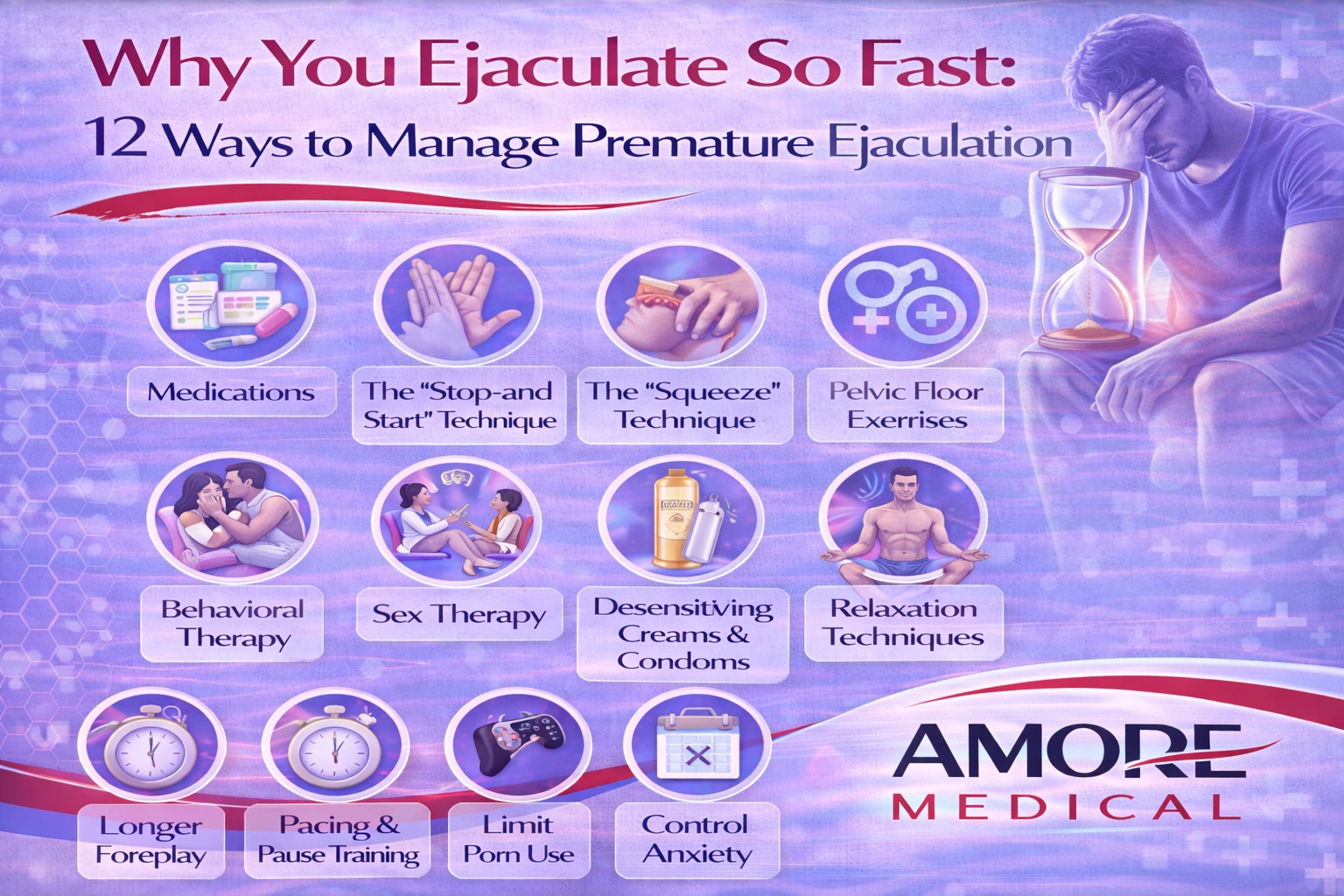
12 Ways to Manage Premature Ejaculation
1. Learn Your Arousal Curve Instead of Waiting Too Long to React
Many men try to stop ejaculation only when they are already too close to the point of no return. By then, there may be very little control left. A better approach is learning the earlier stages of your arousal curve. Notice how your breathing changes, how muscle tension builds, and how sensation shifts just before you lose control. This awareness sounds simple, but it is foundational.
In men’s sexual health, better control often begins with earlier recognition. When you know the signs that you are moving from high arousal into inevitability, you can slow down before your body takes over. That awareness becomes the basis for almost every other technique that follows.
2. Practice the Stop-Start Technique
The stop-start technique remains one of the most practical and well-known behavioral tools for premature ejaculation. The idea is straightforward: during solo stimulation or sex, you stop when you feel yourself getting close to ejaculation, let arousal come down, and then begin again. Over time, this can help you recognize your threshold and build better control around it.
This is not about turning sex into a rigid training session. It is about retraining your timing. Some men begin with solo practice because it is easier to pay attention without the pressure of pleasing a partner in the moment. Once control improves, the same skill can be used during partnered intimacy with much less frustration.
Like most sexual wellness strategies, this works better with patience than with force. You are building awareness and timing, not trying to “win” against your body.
3. Use the Squeeze Technique When It Helps
The squeeze technique is a variation of stop-start. When you are close to ejaculating, stimulation stops and pressure is applied to the penis for several seconds to reduce arousal before resuming. Some men find it helpful, especially early on, while others prefer stop-start because it feels less disruptive.
Its value is not that it feels elegant. Its value is that it can interrupt the reflex long enough for you to regain control. In a sexual wellness setting, this is often best seen as a practice tool rather than the only long-term answer. If it helps you understand your body better, it has done something useful.
4. Change Pace, Depth, or Position Instead of Pushing Straight Through
A common mistake is continuing the same speed and stimulation level even when ejaculation feels very close. That usually makes the outcome more predictable, not less. Sometimes better control comes from changing the rhythm, pausing thrusting, switching positions, or shifting to stimulation that feels less intense for a moment.
This is where partner communication matters. A brief reset does not have to ruin the mood. In fact, couples often feel more connected when they treat these moments as teamwork rather than failure. Slowing down, kissing, focusing on your partner, or shifting to another type of touch can reduce pressure and make sex feel less like a race.
5. Use Condoms Strategically
Condoms can help some men last longer because they reduce sensation. For men who feel highly sensitive, that small change may be enough to improve control without making sex feel unsatisfying. Some also prefer thicker condoms or “climax control” condoms designed to lower sensitivity further.
This is one of the most practical answers to how to stop premature ejaculation because it is simple, low-risk, and easy to try. It also supports safer sex, which matters in any intimate care conversation. A condom will not solve every case, but for some men it meaningfully improves timing.
6. Consider Topical Numbing Products Carefully
Topical sprays, creams, or gels containing numbing ingredients can reduce sensation and help delay ejaculation. This is one of the better-known medical strategies because it directly targets sensitivity. For the right person, it can be effective. But it needs to be used thoughtfully.
Too much product can make sex less pleasurable or transfer numbness to a partner if not used correctly. That is why these products are often most helpful when used with guidance and realistic expectations. They are not a sign of weakness. They are one tool among several that may help reduce reactivity and restore confidence.
7. Train the Pelvic Floor the Right Way
The pelvic floor plays a role in erection quality, orgasm, and ejaculation control. That is why pelvic floor exercises, often called Kegels for men, are sometimes part of a management plan. Strengthening and learning to control these muscles may improve awareness and help some men manage ejaculation more effectively.
But there is an important nuance here: not every pelvic floor needs more tightening. Some men are already carrying too much tension in the pelvis because of stress, anxiety, or over-bracing during sex. In those cases, relaxation is just as important as strengthening. This is why pelvic floor work is most useful when it is done correctly and, when needed, with professional guidance.
In intimate wellness care, this is part of a broader lesson: more effort is not always better. Better coordination is what matters.
8. Reduce the Pressure Around Penetration
Many men notice they are more likely to ejaculate quickly when penetration feels like the main event and all the pressure is loaded onto that moment. This creates a performance mindset that can make the body even more reactive. A healthier approach is expanding what counts as satisfying sex.
If intimacy includes touching, oral sex, mutual stimulation, emotional connection, and less pressure to “prove” control immediately, the nervous system often settles. That makes delayed ejaculation more achievable. Ironically, one of the best ways to last longer is to stop treating penetration as the only part that matters.
9. Use Solo Practice More Intentionally
Some men benefit from masturbating in a more deliberate way rather than rushing to orgasm. If your solo habits have trained your body to climax quickly, especially because of secrecy, time pressure, or habit, that pattern may carry into partnered sex. Practicing more slowly can help retrain your response.
Another strategy some men find helpful is masturbating an hour or two before sex, which may reduce sensitivity and delay ejaculation later. This is not ideal for everyone, and it is not a cure, but it can be a useful option in some situations. The bigger idea is to stop seeing solo sex as separate from partnered sex. Your body learns from repetition.
10. Address Performance Anxiety Directly
Performance anxiety is one of the biggest hidden drivers of premature ejaculation. When your mind is scanning for whether you will lose control, whether your partner is satisfied, or whether you are “failing,” your body does not stay relaxed. It becomes tense, vigilant, and reactive.
That is why breathing, pacing, and honest communication matter so much. Slower breathing can reduce physical tension. Talking openly with a partner can reduce the secrecy and shame that make the cycle worse. Some men also benefit from counseling or sex therapy, especially when premature ejaculation is tied to fear, relationship strain, past embarrassment, or chronic anxiety.
This is not just mental. It is physical. The nervous system and the sexual response system are closely connected.
11. Do Not Ignore Erectile Changes
Sometimes premature ejaculation is partly driven by erectile concerns. If a man worries he may lose his erection, he may rush unconsciously toward orgasm before firmness changes. In that case, the issue is not only ejaculation. It is a combination of performance pressure and erection instability.
This is especially relevant in sexual medicine clinics because erectile dysfunction and premature ejaculation can overlap. If erections have become less predictable, less firm, or harder to maintain, addressing erection quality may improve ejaculation control too. This is one reason a full evaluation can be more useful than guessing. What looks like one problem may actually be two connected issues.
12. Know When to Seek Professional Treatment
If premature ejaculation is happening regularly, causing distress, affecting your relationship, or not improving with self-help strategies, it is time to talk to a provider. In many cases, this leads to the most meaningful progress. A clinician can help determine whether the issue appears lifelong or acquired, whether anxiety or pelvic tension is contributing, whether erection problems are involved, and whether prescription treatment may help.
Professional treatment may include counseling, guided behavioral work, topical numbing therapy, or medication. Some prescription options are used specifically because they can help delay ejaculation, but these should be chosen based on your overall health, symptoms, and goals. The point is not to jump straight to medication for everyone. The point is to know that you do not have to solve this alone.
What Usually Works Best: Combination, Not Perfection
One reason men get discouraged is that they try one tip once and expect a complete turnaround. Premature ejaculation usually responds better to layering strategies. Someone might combine better awareness, stop-start practice, condoms, lower performance pressure, and treatment for mild erectile issues. Someone else might need counseling plus a topical product. Another person may improve significantly with pelvic floor work and partner communication.
That is how real sexual wellness tends to work. The best answer to how to stop premature ejaculation is rarely a single trick. It is a personalized approach that matches the reason the pattern is happening in the first place.
Questions Men Commonly Ask
Is premature ejaculation always psychological?
No. Stress and anxiety can contribute, but premature ejaculation is not always “in your head.” Sensitivity, conditioning, pelvic floor patterns, erection concerns, and other medical factors may all be involved. Often it is a mix of physical and psychological influences.
Can it get better on its own?
Sometimes, especially if it is situational and related to temporary stress or a new partner. But if it has become a repeated pattern, active strategies usually help more than waiting and hoping.
Does having sex more often fix it?
Not necessarily. Some men find they last longer when they are having sex more regularly, but frequency alone is not a reliable cure. Without better control, the same pattern can keep repeating.
Should I feel embarrassed talking to a doctor about it?
No. Premature ejaculation is one of the most common concerns in men’s intimate health. A good provider will treat it as a medical and quality-of-life issue, not something shameful.
When It Is Time to Get Evaluated
You should consider professional help if you usually ejaculate sooner than you want, feel unable to delay it, or notice that the issue is affecting your confidence, sexual satisfaction, or relationship. It is also worth getting checked if the problem started later in life, especially if erections have changed too. That pattern sometimes points to a broader sexual health issue that deserves attention.
At Amore Medical, sexual wellness is approached in exactly this way: discreetly, practically, and with an understanding that intimacy concerns often overlap with confidence, circulation, hormones, stress, and relationship health. Premature ejaculation is not a character flaw. It is a treatable sexual health concern, and the right plan can make a real difference.
A Better Goal Than “Never Again”
If you are dealing with premature ejaculation, try to aim for progress rather than perfection. The goal is not to become robotic or endlessly self-monitoring. The goal is to feel more in control, less anxious, and more able to enjoy sex without bracing for disappointment. That shift alone can change a lot.
The men who usually improve are not the ones who shame themselves the hardest. They are the ones who get curious, practice consistently, communicate honestly, and seek help when self-directed strategies are not enough. That is a much healthier and more effective path forward.
Premature ejaculation can feel intensely personal, but it is also manageable. With the right combination of practical techniques, awareness, and support, many men do improve. And that means your sex life does not have to stay trapped in the same pattern.