If you are researching shockwave therapy for erectile dysfunction, there is a good chance you are looking for something more meaningful than a temporary fix. Many men who start exploring ED treatment are not only asking how to get an erection tonight. They are also asking whether there is a non-surgical option that may support sexual function, restore confidence, and make intimacy feel less stressful over time. That is exactly why shockwave therapy has become such an important topic in modern sexual wellness care.
At the same time, it helps to approach the subject with clarity instead of hype. Shockwave therapy is real. It is used in urology and sexual medicine. It may help selected men, especially those with a vascular pattern of erectile dysfunction. But it is not a universal cure, and it should not be discussed as though every man with ED will respond in the same way. The strongest care plans start with understanding the cause of the problem first, then deciding whether this treatment actually fits.
At Amore Medical, sexual health is approached with that bigger perspective in mind. Erectile dysfunction affects more than physical performance. It can affect self-esteem, spontaneity, communication, and the ability to feel present with a partner. A treatment conversation should take all of that seriously. It should not be reduced to a quick prescription or a generic sales pitch. It should be personal, medically grounded, and realistic about what may help.
This guide explains how shockwave therapy for erectile dysfunction works, who may benefit most, what current evidence suggests, and what patients should expect from this non-invasive sexual wellness option. The goal is not to overpromise. It is to help you understand whether this treatment may belong in your care plan and why it has become such a strong part of the non-surgical ED conversation.
Why Erectile Dysfunction Happens in the First Place
Before shockwave therapy makes sense, it helps to understand what erectile dysfunction actually is. Erections depend on several systems working together. Blood flow has to be strong enough to fill the penis. Nerve signaling has to be intact. Hormones have to support libido and responsiveness. Mental focus and emotional ease also matter, because stress and pressure can disrupt the body’s ability to respond even when the physical structures are still capable.
This is why ED is not one single problem with one single cause. In some men, the main issue is circulation. In others, medication side effects, low testosterone, sleep problems, anxiety, relationship strain, or a mix of factors may be involved. The same symptom—difficulty getting or keeping an erection—can come from very different underlying patterns. That is one reason good sexual medicine starts with evaluation, not assumptions.
Shockwave therapy enters the conversation most naturally when the ED pattern appears to be vascular. That means the issue seems tied closely to blood vessel function and blood flow. This is the group of patients most often discussed in the research and in clinical guidelines.
What Shockwave Therapy for Erectile Dysfunction Actually Is
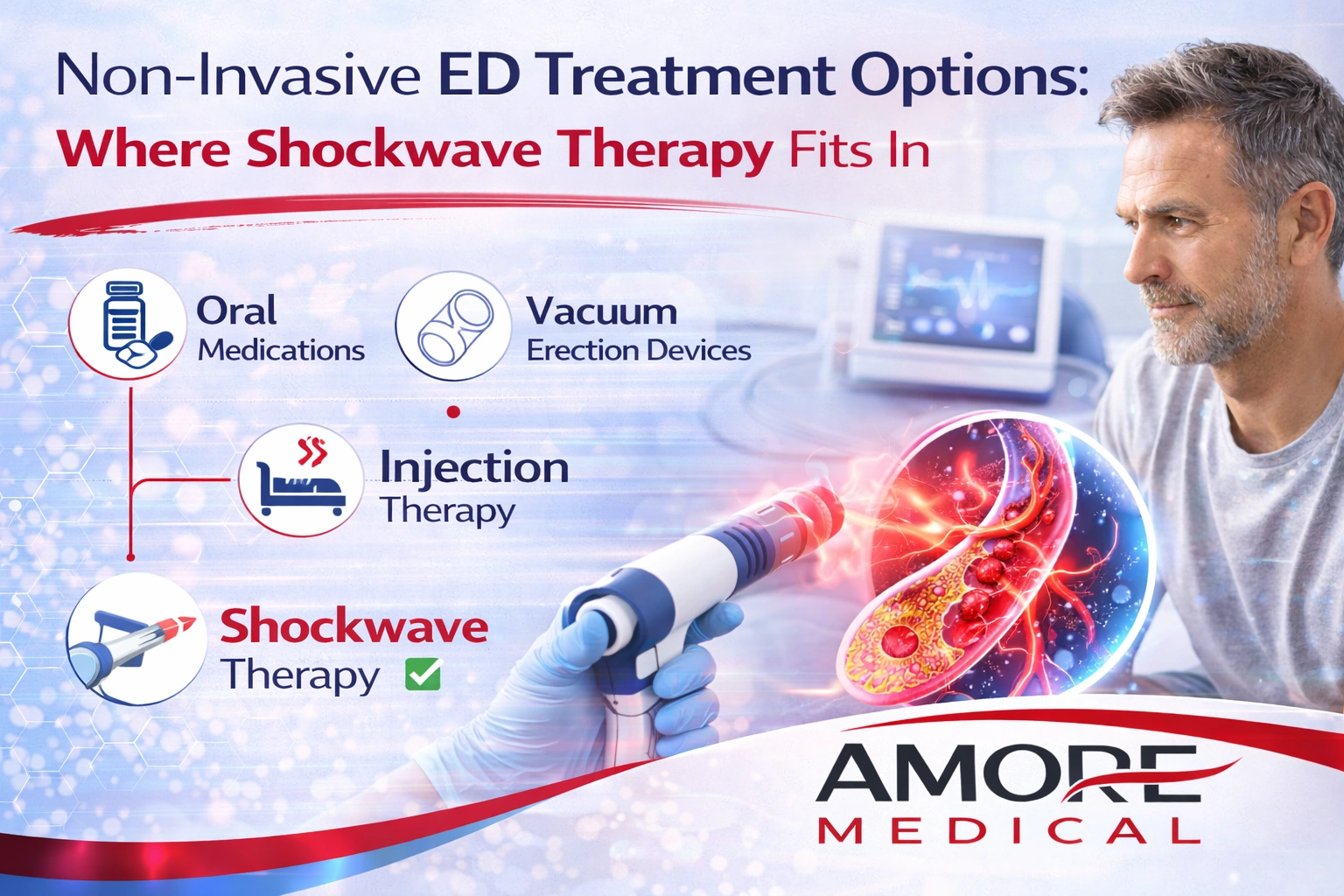
Shockwave therapy for ED usually refers to low-intensity extracorporeal shock wave therapy, sometimes shortened to Li-ESWT. In practical terms, it is an office-based treatment that uses targeted acoustic energy delivered to penile tissue in a structured series of sessions. It is non-invasive, which means there is no incision, no implant, and no traditional surgical recovery. That alone makes it very appealing to men who want an option beyond pills and surgery.
It is also different from standard ED medication in one important way: it is not designed to be taken right before sex. Instead, it is discussed as a treatment that may support erectile function over time in selected patients. For many men, that changes the whole tone of the conversation. Instead of asking only what works in the moment, they begin asking whether there is a treatment path that feels more restorative and less dependent on timing intimacy around a medication.
That said, the word “restorative” should still be used carefully. Shockwave therapy is a real treatment, but not a guarantee. It belongs in the category of promising non-surgical options for the right patient, not miracle solutions for every form of ED.
How Shockwave Therapy Works
At a basic level, shockwave therapy uses acoustic pulses applied to tissue in a controlled way. In sexual medicine, the treatment is discussed mainly in relation to blood-flow-related erectile dysfunction. That is because erection quality depends heavily on the health of the penile blood vessels. If those vessels are not responding well, erections may be softer, slower to develop, or harder to maintain.
In men’s intimate health and restorative sexual wellness care, this matters because not every erection problem is the same. Some men are dealing mostly with stress or performance anxiety. Others are dealing with hormone-related symptoms. But when the pattern looks vascular, meaning circulation appears to be a meaningful part of the problem, focused shockwave therapy becomes much more relevant to the conversation.
The treatment itself is non-invasive and office-based. Rather than relying on a pill taken before sex, shockwave therapy is delivered as a series of sessions over time. The idea is not simply to create an erection in the moment. It is to support erectile function in a way that may fit a broader sexual wellness plan for the right patient.
Why Blood-Flow-Related ED Is the Main Focus
To understand where shockwave therapy fits, it helps to understand how erections work. During sexual arousal, blood vessels in the penis need to widen so blood can flow into erectile tissue and stay there long enough to create firmness. When circulation is reduced or the blood vessels are not functioning well, the result may be weaker erections, slower erections, or erections that fade too easily.
That is why this treatment is most often discussed in connection with vascular erectile dysfunction. In performance wellness and sexual health care, a man with gradual changes in erection quality, especially alongside blood pressure issues, diabetes, cholesterol concerns, smoking history, or other vascular risk factors, often sounds very different from a man whose symptoms are mostly situational or stress-driven. Good care recognizes that difference instead of treating all ED exactly the same way.
What the Treatment Process Usually Involves
In private sexual wellness practice, shockwave therapy is typically performed using a handheld device that delivers low-intensity acoustic energy to targeted treatment areas. The sessions are usually brief, and because the treatment is non-surgical, there is generally no incision, implant, or traditional surgical recovery period to plan around. For many patients, that is one of the biggest reasons the treatment feels approachable. It can fit into a normal schedule much more easily than people often expect.
The treatment is also usually done as a course rather than as a one-time visit. That is important because this option is not framed as an instant fix. In intimate medicine, it is usually presented as a non-invasive treatment path that may help selected men over time. The exact number of sessions and timing can vary by patient and by protocol, which is why a personalized treatment plan matters more than a one-size-fits-all schedule.
Why This Option Appeals to So Many Men
One reason focused shockwave therapy has become such an important part of the men’s sexual health conversation is that many patients want an option beyond pills without jumping straight to surgery. They want something that feels modern, non-invasive, and aligned with a more restorative model of care. In many cases, they are not only looking for stronger erections. They are looking for more confidence, more consistency, and less dependence on short-term solutions.
That makes this treatment especially relevant in an intimate wellness practice. When used thoughtfully, it may help the right patient feel that he is working on the bigger pattern behind the symptom, not only reacting to the symptom in the moment. That mindset often matters just as much emotionally as it does physically.
What Patients Should Understand Before Starting
Even in a treatment-forward sexual wellness setting, the most important thing to understand is that shockwave therapy is not for every man with ED. A patient still needs a proper evaluation to determine whether the symptoms appear primarily vascular, hormonal, emotional, medication-related, or mixed. That kind of clarity protects the patient from choosing a treatment that sounds appealing but does not actually match the cause of the problem.
This is also why expectation-setting matters. Focused shockwave therapy may be a strong non-invasive option for selected patients, but it should be explained in a measured, medically grounded way. The point is not to promise perfect results. The point is to help the right patient explore a credible treatment that may support better erectile function as part of a broader, personalized sexual health plan.
The treatment is intended to act locally, which is one reason it is attractive to patients who want an office-based approach. It does not rely on systemic medication in the same way pills do. Instead, it is used as a targeted therapy in a series of visits, usually over several weeks.
STORZ MEDICAL, the manufacturer of the DUOLITH SD1/Ultra platform often used in this setting, positions focused shockwave therapy as a non-invasive option for vascular ED and related urologic indications. That aligns with how many sexual wellness practices discuss the treatment: as a focused, office-based option for carefully selected patients. ([storzmedical.com](https://www.storzmedical.com/en/disciplines/introduction-urology/))
Why Blood Flow Matters So Much for Erections
An erection is fundamentally a blood flow event. During arousal, blood vessels in the penis need to widen so blood can move in and create firmness. If circulation is weak or the blood vessels are not functioning well, the penis may not fill or stay firm the way it once did. This is why ED often shows up gradually in men with high blood pressure, diabetes, high cholesterol, obesity, smoking history, or broader cardiovascular risk.
This is also why many men with vascular ED still have some erectile response. The issue is not always total absence. More often, it is a decline in quality and dependability. Erections may still happen, but they may not feel as strong, may not last as long, or may fade under pressure. That pattern is exactly why a non-surgical treatment aimed at the vascular side of erectile function has become such an important option to discuss.
In other words, shockwave therapy tends to make the most sense when the question is not “Can I ever get an erection?” but “Why are my erections less dependable than they used to be, especially when blood flow seems to be part of the story?”
Who May Benefit the Most
The men most often discussed as good candidates for shockwave therapy for erectile dysfunction are those with mild-to-moderate vasculogenic ED. In real life, that often means a man who still has some erectile function, but not the consistency, rigidity, or confidence he wants. Erections may still happen, but they may not feel dependable enough for satisfying intimacy.
A patient who may fit this conversation often looks like someone who:
- has had a gradual decline in erection quality rather than a sudden total loss,
- still responds to arousal, but not as well as before,
- has risk factors that suggest a vascular pattern,
- wants a non-surgical option,
- is interested in something beyond pill-only treatment.
Some men who get a partial response from ED medication also fit this group well. They may say the pills help, but not enough, or that they do not want to rely on them every time. For that type of patient, shockwave therapy often feels especially relevant.
Who May Need a Different First Step
Not every man with ED is automatically the right candidate for shockwave therapy. That is one of the most important things to understand. If the main issue seems hormonal, medication-related, psychological, or primarily tied to low libido rather than erection quality, a different first step may make more sense. A man with strong fatigue, reduced desire, and other hormone-related symptoms may need testing before he needs a device-based treatment. A man whose erections are much better alone than with a partner may need to address anxiety or relationship strain more directly.
This is not a weakness of shockwave therapy. It is simply how good medicine works. The right treatment has to match the likely cause. NIDDK notes that erectile dysfunction can result from conditions affecting blood vessels, nerves, or hormones, and can also be linked to medicines, emotional issues, and lifestyle behaviors. That is exactly why candidacy matters so much. ([niddk.nih.gov](https://www.niddk.nih.gov/health-information/urologic-diseases/erectile-dysfunction/symptoms-causes))
What Current Evidence Suggests
The evidence around shockwave therapy is encouraging enough to take seriously, but not settled enough to oversell. That is the most honest summary. The European Association of Urology says that low-intensity shockwave therapy is able to induce a mild improvement in erectile function among patients with vasculogenic ED. That language is useful because it supports the treatment while still keeping expectations grounded. “Mild improvement” may still matter a great deal in real life, especially for a man whose erections have become less reliable. ([uroweb.org](https://uroweb.org/guidelines/sexual-and-reproductive-health/chapter/management-of-erectile-dysfunction))
At the same time, the American Urological Association continues to consider low-intensity shockwave therapy investigational for men with ED. That reflects the fact that study protocols still vary, devices differ, and evidence quality is not perfectly uniform. In other words, the treatment is promising and clinically relevant, but the field is still evolving. ([auanet.org](https://www.auanet.org/documents/guidelines/ed%20website%20final.pdf))
For many patients, that balanced answer builds more trust than a hard sell ever could. A treatment does not need to be universal to be valuable. It just needs to be used thoughtfully in the right patient.
What to Expect During Treatment
Patients are often relieved to learn that the treatment experience is usually much less dramatic than they imagined. Shockwave therapy is generally delivered in a clinic setting with a handheld device. The sessions are usually brief and do not require surgical preparation, anesthesia, or the kind of downtime people associate with invasive procedures.
In many clinical descriptions, sessions last around 15 minutes and are repeated in a series over several weeks. The exact number of sessions can vary because there is no single universal protocol used everywhere, but many real-world treatment plans fall in the range of about 6 to 12 sessions. That is one reason patients should always ask how many visits are being recommended and why. ([health.clevelandclinic.org](https://health.clevelandclinic.org/shockwave-therapy-for-ed))
Most men describe the treatment as tolerable. It may feel unusual, but it is generally discussed as manageable rather than intensely painful. The bigger commitment is usually the schedule itself, not the discomfort of one individual visit.
When Men May Notice a Difference
One of the most common questions is how soon improvement should happen. The answer is that timing varies. Some men report changes during the treatment course, while others notice gradual improvement later. The healthiest expectation is not to watch for a dramatic shift after one session, but to think in terms of gradual improvement in erection quality, consistency, or confidence over time.
This is another place where realism helps. If the therapy is framed properly, patients understand that success may mean firmer erections, more dependable response, less anxiety around sex, or reduced reliance on other support. It does not need to mean perfection to be meaningful.
Does It Replace ED Medication?
Not necessarily. Some men pursue shockwave therapy because they want to rely less on medication. Others use medication and shockwave therapy as part of the same broader sexual wellness plan. The answer depends on the patient, the cause of the ED, and the kind of response he gets.
A thoughtful clinic should not promise that shockwave therapy automatically eliminates the need for pills. A more honest approach is to explain that some men may feel less dependent on medication over time, while others may still benefit from combining treatments. The right plan is the one that improves function and confidence in a way that fits real life.
Why Lifestyle and Whole-Person Care Still Matter
Even when a man is a good candidate for shockwave therapy, it still helps to remember that erections are connected to the rest of health. Blood pressure, blood sugar, sleep, physical activity, smoking, stress, and relationship comfort all influence erectile function. This is why the strongest care plans do not isolate one treatment as if it exists alone.
At Amore Medical, shockwave therapy fits best inside a broader sexual wellness model. That means looking at vascular health, hormones, lifestyle, emotional stress, and intimacy patterns rather than treating the penis as if it is separate from the rest of the body. For many men, that is where the biggest difference is made. They are not only getting a treatment. They are finally getting a plan.
What This Means at Amore Medical
At Amore Medical, shockwave therapy for erectile dysfunction is not presented as a generic answer for all men. It is discussed as a non-invasive sexual wellness option that may help the right patient, especially when the ED pattern appears vascular and the patient wants to explore something beyond pill-only care. The value of the treatment is strongest when it is matched to the patient’s symptoms, expectations, and goals.
That is what makes the conversation more trustworthy. Some men may be strong candidates. Others may need a different first step. What matters is that the treatment plan is based on a real understanding of what is driving the problem and what kind of improvement the patient is truly seeking.
For men who feel frustrated, less confident, or less spontaneous because erections are not what they used to be, that kind of personalized, non-surgical care can be an important turning point. Not because it promises everything, but because it offers a realistic path forward built around how sexual function actually works.