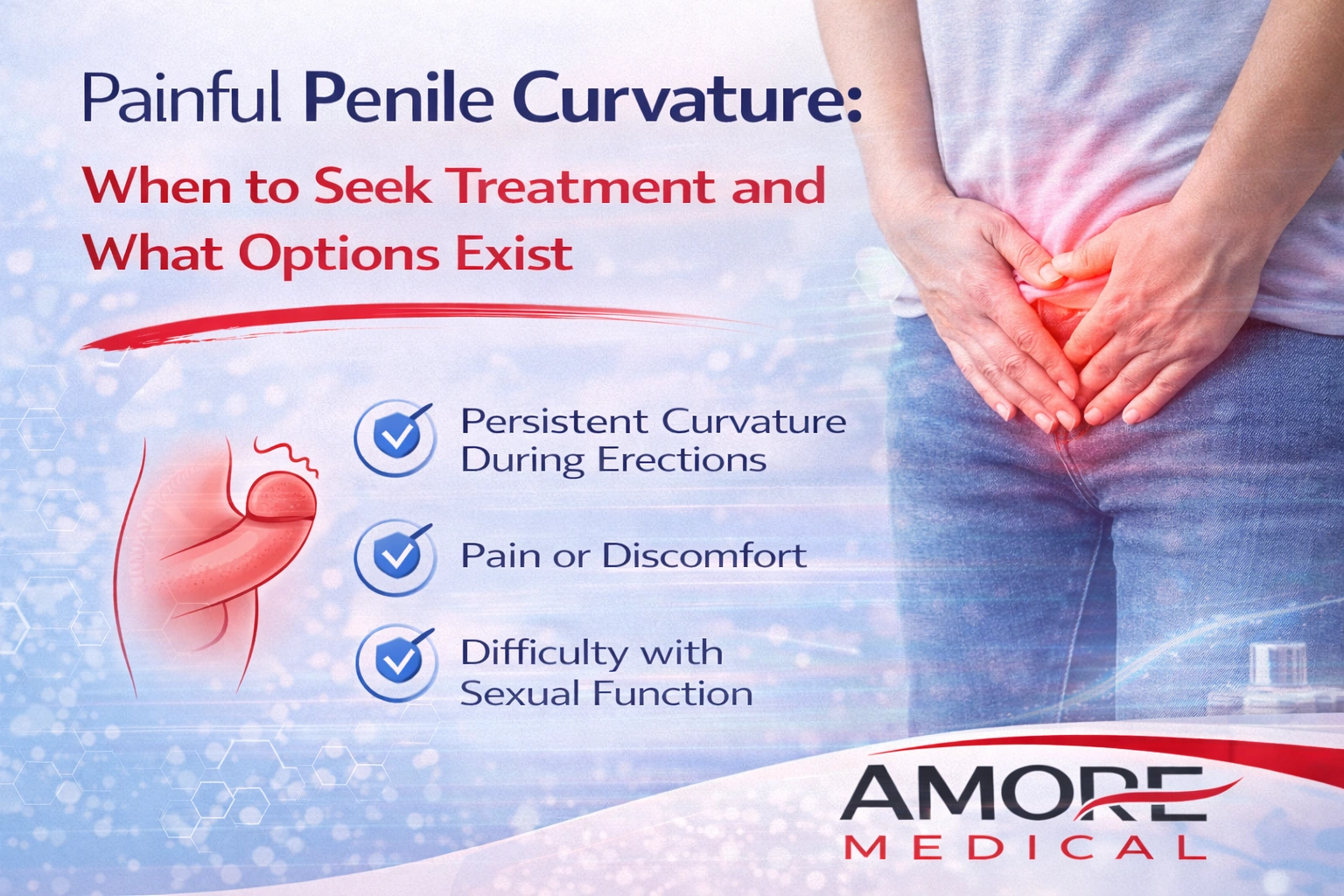
If you have noticed a bend in your penis that feels new, painful, or more obvious than before, it is understandable to feel alarmed. Many men do not know whether a curve is normal, whether it signals an injury, or whether it could affect sex, erections, or long-term confidence. The good news is that not every curve is a medical problem. The more important news is that painful penile curvature treatment should start with understanding what kind of curvature you are dealing with and whether it is changing over time.
Some men have had a slight curve for as long as they can remember and never had pain or functional issues. Others notice a new bend that seems to appear over weeks or months, often with pain during erections, a lump or firm area in the shaft, loss of length, or difficulty with sex. That second pattern is often more concerning, especially when the curve is new and painful. In many cases, this points to Peyronie’s disease, a condition in which scar tissue forms in the penis and changes the way it bends during erection.
For a sexual wellness audience, this topic matters for more than anatomy alone. Painful penile curvature can affect confidence, make sex difficult or emotionally stressful, and create fear around erections. Some men begin avoiding intimacy because they are worried about pain or embarrassment. Others become concerned that the curve means permanent damage or that their sex life is over. In reality, treatment options do exist, and the earlier the issue is understood, the easier it is to make informed decisions.
At Amore Medical, sexual health is approached with discretion, clarity, and practical support. The goal is not only to address symptoms, but also to help patients feel less anxious and more confident about what comes next. This article explains what painful penile curvature may mean, when it makes sense to seek care, what conditions are most commonly involved, and which options may help improve comfort and function.
When a Penile Curve Is Normal and When It Is Not
Not all penile curvature is a disease. Many men have erections that are not perfectly straight. A small lifelong curve, especially one that has always been there and does not cause pain or trouble with sex, may simply be a normal variation. Cleveland Clinic notes that most people do not have perfectly straight erections and that a slight lifelong curve does not automatically mean Peyronie’s disease. That is an important starting point because unnecessary fear often begins with comparing normal anatomy to unrealistic expectations.
What changes the conversation is pain, progression, or function. A curve that is new, getting worse, associated with a firm plaque or lump, or causing pain with erections deserves more attention. The same is true if the penis appears shorter, narrower in one area, or begins to take on an hourglass shape. These are not small details. They help separate harmless variation from a condition that may need treatment.
In practical terms, the most concerning pattern is not “my penis has a slight bend.” It is “my penis did not used to curve like this, and now it hurts or interferes with sex.” That is when a professional evaluation becomes much more useful than guessing.
The Most Common Cause: Peyronie’s Disease
The condition most often linked to painful new penile curvature is Peyronie’s disease. This happens when fibrous scar tissue, called plaque, develops in the penis and changes the way it expands during erection. Because the scarred area does not stretch normally, the penis may bend upward, downward, or to one side. In some men, the main issue is the curve itself. In others, the scar tissue causes narrowing, indentation, shortening, pain, or weaker erections.
Peyronie’s disease often develops in two phases. In the acute or active phase, scar tissue is forming and the curve may change. This is also when pain during erection is most common. Cleveland Clinic notes that the acute phase usually lasts about six to twelve months, and Mayo Clinic describes the active phase as a period when pain and deformity may worsen or continue evolving. Later, the condition may enter a more stable phase, when the curve stops changing and pain often improves, even though the deformity itself may remain.
This timeline matters because treatment decisions often depend on whether the condition is still changing or has stabilized. Early pain does not always mean emergency, but a curve that is getting worse deserves attention sooner rather than later.
What Symptoms Often Go Along With Painful Curvature
Men often focus first on the bend, but painful penile curvature usually comes with a wider symptom pattern. A person with Peyronie’s disease may notice:
- pain during erections,
- a bend upward, downward, or to one side,
- a lump or hard band under the skin,
- loss of length or girth,
- an hourglass or narrowing effect,
- softer erections or erectile dysfunction,
- difficulty or pain during sex for themselves or their partner.
These symptoms can develop quickly or more gradually. Mayo Clinic notes that Peyronie’s symptoms may begin suddenly or appear over time, and Cleveland Clinic notes that the condition can make sex difficult or impossible in some cases. Some men are most troubled by pain. Others are more affected by the physical bend or by erections that no longer feel dependable. The emotional burden can be just as significant as the physical one.
When It Is Not Peyronie’s Disease
While Peyronie’s disease is the most common explanation for new painful curvature, it is not the only possibility. Congenital penile curvature is present from birth and is usually noticed earlier in life. It tends to be stable, not painful, and not associated with a plaque. Trauma is another important cause. A severe bend or blow to an erect penis can cause a penile fracture, which is a medical emergency rather than a wait-and-see problem.
This is a critical distinction. A penile fracture typically involves a sudden injury during an erection, often with immediate pain, a popping or cracking sound, rapid loss of erection, swelling, bruising, and sometimes blood in the urine. Cleveland Clinic and Mayo Clinic both describe this as an emergency that usually requires urgent evaluation. That is very different from the slower pattern seen with Peyronie’s disease.
In other words, a curve that slowly develops with pain over weeks or months is one conversation. A sudden painful bend after trauma with popping and bruising is another entirely.
When to Seek Treatment Promptly
Men often wait longer than they should to bring up penile symptoms, usually because of embarrassment or the hope that things will go away on their own. But painful curvature is not something you need to quietly tolerate. Mayo Clinic advises seeing a healthcare professional if you notice symptoms of Peyronie’s disease, because earlier treatment offers the best chance to keep the condition from worsening or to improve symptoms.
It is a good idea to seek evaluation if:
- the curve is new or getting worse,
- erections are painful,
- sex has become difficult or impossible,
- you can feel a plaque or hard area,
- your penis looks shorter, narrower, or indented,
- you are losing erection rigidity,
- you are avoiding intimacy because of the problem.
And again, urgent care is especially important if the symptoms began after sudden trauma and include a pop, bruising, immediate loss of erection, or blood at the tip of the penis or in the urine. That pattern is more consistent with penile fracture and should not be managed like Peyronie’s disease.
What Evaluation Usually Involves
A strong evaluation begins with history. A clinician will usually ask when the curve began, whether it is changing, whether there is pain with erections, whether sex is possible, and whether erectile quality has changed. They may also ask whether the condition followed an injury, whether you can feel a plaque, and whether there are related concerns such as diabetes, connective tissue disorders, or prior prostate treatment.
A physical exam often includes checking for plaque or thickened tissue. In some cases, especially when planning treatment, clinicians may want to document the curve during erection or use imaging such as ultrasound. The European Association of Urology notes that evaluation should include the degree of curvature, erectile function, penile length, and whether the disease appears active or stable, because those details influence treatment timing and choice.
This is one reason self-diagnosis only goes so far. A man may know that something feels wrong, but deciding whether it is active Peyronie’s disease, stable Peyronie’s disease, congenital curvature, or trauma-related injury often requires a professional exam.
Painful Penile Curvature Treatment in the Early Phase
When the disease is still active and pain is part of the main complaint, treatment often starts conservatively. The immediate goals are usually to manage pain, monitor whether the curve is progressing, preserve sexual function, and decide whether the condition is stabilizing or still evolving.
For pain, the EAU guideline recommends nonsteroidal anti-inflammatory drugs during the acute phase. This does not remove the plaque or straighten the penis, but it may improve comfort while the condition is evolving. The guideline also says extracorporeal shockwave treatment may be offered for penile pain in the acute phase, but it does not improve penile curvature or plaque size. That is an important nuance: a therapy might help pain without correcting the bend itself.
During this stage, many men are also advised to avoid unrealistic expectations about over-the-counter pills or internet supplements. They may promise to “dissolve scar tissue,” but guideline-based evidence does not support many of the popular oral products marketed for Peyronie’s disease. The EAU specifically advises against several commonly promoted oral therapies, including vitamin E and pentoxifylline, for treating Peyronie’s curvature.
Traction Therapy and Non-Surgical Options
For men who want a non-surgical approach, traction therapy often becomes part of the discussion. Mayo Clinic notes that penile traction therapy is recommended in the early phase and is the only treatment shown to improve penis length. It may also be used later in the disease or alongside other treatments. The EAU guideline says traction may reduce curvature and increase penile length, although the available studies have important limitations.
Traction therapy is not a fast or casual option. It typically requires a device worn for a set amount of time each day, sometimes for months. That level of commitment is one reason some patients are interested in it and others are not. But for a man concerned about shortening or gradual worsening, it may be a useful part of a structured non-surgical plan.
Other non-surgical options may include intralesional injections. Among the best known is collagenase clostridium histolyticum. The EAU guideline says intralesional collagenase has shown significant decreases in penile curvature in men with stable disease, and Mayo Clinic notes that collagenase can improve curving and bothersome symptoms, especially when combined with modeling or traction. This is not appropriate for every case, but it is one of the main evidence-based non-surgical treatments used in selected patients with stable Peyronie’s disease.
When Surgery Enters the Conversation
Surgery is usually not the first conversation, but it can become the right one when the deformity is severe, intercourse is difficult or impossible, or non-surgical treatment has not provided enough improvement. The key point is timing. Surgery is generally reserved for stable disease rather than the actively changing phase.
Mayo Clinic says surgery is usually not recommended until Peyronie’s disease has been present for about nine to twelve months and the curve has been stable for at least three to six months. The EAU guideline similarly recommends operating only after the disease has been stable for at least three months and usually about twelve months from symptom onset, especially when intercourse is compromised.
Surgical options vary based on the type of deformity, erectile function, and penile length. Broadly, they may include plication procedures, lengthening procedures with grafting, or penile prosthesis placement if erectile dysfunction is also significant. The right operation depends on the man’s goals and anatomy, and a good surgeon should explain not only the potential benefits but also the tradeoffs, such as shortening, residual curve, numbness, or ED risk.
How Painful Curvature Affects Erections and Confidence
One reason this condition can feel so disruptive is that it affects both the body and the mind. Peyronie’s disease can interfere with how the penis stores blood, and Cleveland Clinic notes that it can cause erectile dysfunction for that reason alone. But even before ED appears physically, anxiety can start affecting the sexual experience. A man may worry about pain, the appearance of the curve, or whether his partner is uncomfortable. That mental load can make erections less reliable even when blood flow is not the main issue.
This is why painful penile curvature often becomes a sexual wellness issue, not just an anatomical one. The patient is not only asking, “Can this be treated?” He is also asking, “Can I still have a satisfying sex life? Can I feel normal? Can I stop dreading sex?” Those are real medical and emotional questions.
Addressing confidence often means treating the condition itself while also giving the patient a realistic roadmap. Knowing what phase the disease is in, what options exist, and what outcomes are realistic can significantly reduce the fear that everything is getting worse with no plan.
Why Early, Honest Treatment Conversations Matter
One of the worst things about painful penile curvature is how isolating it can feel. Many men delay care because they assume nothing can be done, or because they are embarrassed to describe what is happening. But Peyronie’s disease is not rare, and treatment options have improved. Mayo Clinic notes that even when the disease has been present for some time, treatment may still help ease pain, curving, and shortening.
That does not mean every man needs immediate intervention. Some need reassurance, pain control, and monitoring. Others benefit from traction. Others may be good candidates for injections. Others eventually need surgery. The key is not to make assumptions based on shame or internet myths. The key is to get the condition evaluated, understand the phase, and build a plan based on function and goals.
What This Means at Amore Medical
At Amore Medical, sexual health care is about more than a symptom in isolation. Painful penile curvature affects comfort, confidence, erection quality, and intimacy. That means the best care is not only about whether a curve exists. It is about how it affects your life, whether it is progressing, whether it is hurting, and which treatment path is most appropriate for your stage and goals.
For some men, that means non-surgical support and monitoring. For others, it means referral into a more specialized treatment path. What matters most is that the problem is taken seriously and addressed with clarity, not shame.