If you have ever wondered when does the penis stop growing, you are asking a very common question. It is one that sits at the intersection of anatomy, puberty, body image, and sexual confidence. For many people, the question starts in adolescence. For others, it continues into adulthood, especially if they are comparing themselves to unrealistic images online or wondering whether they “missed” some stage of development.
The most useful answer is that penis growth usually happens during puberty, not forever, and it does not stop on one exact birthday for everyone. Like height, voice changes, and facial hair, genital development follows a general pattern but still varies from person to person. Some males reach adult genital size relatively early in the teen years. Others develop later and do not finish until the later teen years. That variation is usually normal.
In sexual wellness care, the bigger goal is not only answering the timing question. It is helping people understand what normal variation looks like, what changes are expected during puberty, what does not change size, and when a concern deserves real medical attention instead of more comparison and guesswork. That kind of clarity can reduce anxiety and make conversations about sexual health much more grounded.
When Does the Penis Stop Growing?
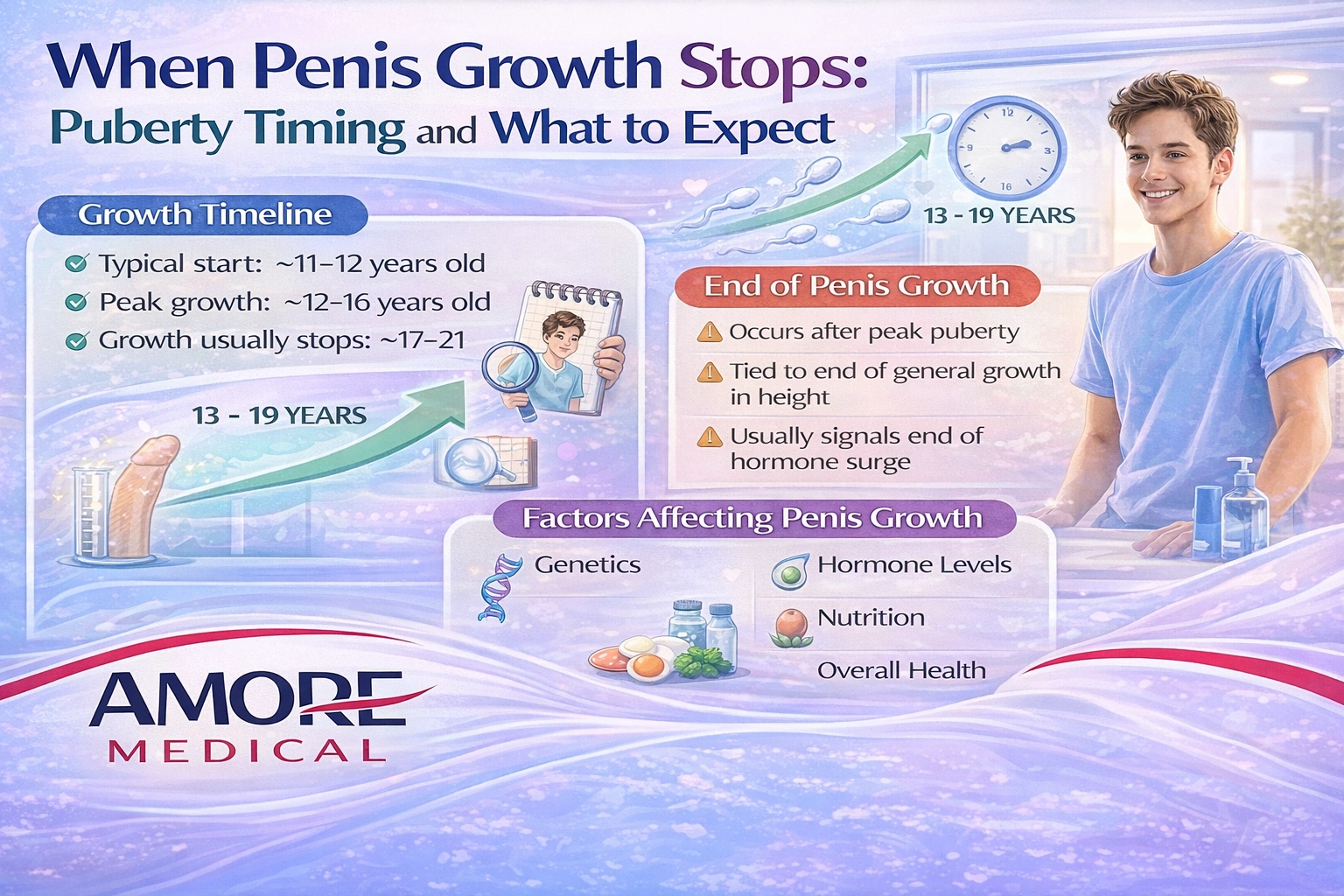
The short answer is that the penis usually grows during puberty and is often close to adult size by the late teen years. But there is no single age that fits everyone. Puberty itself starts at different times, moves at different speeds, and does not unfold in exactly the same order for every person. That is why one teenager may seem fully developed much earlier than another, even when both are healthy.
In practical terms, penile growth most often begins after puberty starts and continues through the pubertal years. A person may notice length changes first and then more change in width later. By the time puberty is finishing, genital growth is usually slowing down or complete. This is why the question when does the penis stop growing is best answered with a range rather than a single age. The body follows a process, not a deadline.
That point matters because a lot of anxiety comes from comparing one person’s timeline to another’s. Puberty is not a race. It is a developmental window. If someone starts later, they often also finish later. That can feel stressful in the moment, but it does not automatically mean anything is wrong.
How Penis Growth Usually Happens During Puberty
Puberty in males is driven by hormonal changes, especially rising testosterone production from the testicles. Those hormonal signals affect many parts of the body at once. The testicles enlarge, pubic hair develops, the penis grows, the voice deepens, muscle mass increases, and growth in height accelerates. Because several changes are happening together, genital development is usually one piece of a broader pubertal pattern rather than a stand-alone event.
One detail many people do not realize is that growth does not always feel dramatic from week to week. It is often gradual. Someone may feel nothing is happening, then look back a year later and notice that a lot actually changed. That slow progression is part of why constant checking or comparison can become so frustrating. The body is moving, just not in a day-to-day way that is easy to measure with confidence.
Another important point is that genital development does not look identical in every person. Some males notice changes earlier in the testicles than in the penis. Others are more aware of pubic hair or height changes before they think much about genital size. That variation in sequence is one reason doctors look at the whole puberty picture instead of using one body part as the entire assessment.
Common Puberty Changes That Often Happen Around the Same Time
During puberty, it is normal to notice a mix of changes, including:
- enlargement of the testicles and scrotum,
- growth of the penis in length and later width,
- pubic and underarm hair,
- more frequent erections, including spontaneous erections,
- ejaculation and wet dreams,
- a deeper voice, and
- a general growth spurt in height and muscle mass.
Seeing some of these changes but not others yet does not automatically mean there is a problem. Bodies develop in phases, and some features catch up later.
Normal Variation Is Wider Than Most People Think
One of the biggest reasons this subject creates anxiety is that people often assume there is a narrow window for what is normal. In reality, there is a broad range of normal development. That includes timing, shape, flaccid appearance, and erect appearance. Two healthy people can be very different in how they look during puberty and still both fall within a normal developmental range.
This is especially important when it comes to size. Flaccid size varies a lot from person to person and can also change from moment to moment depending on temperature, stress, blood flow, and activity. That means a penis may look smaller in one setting and fuller in another without any actual long-term change. Erect size tends to be more consistent than flaccid appearance, which is one reason flaccid comparison is often so misleading.
Shape varies too. Some penises hang more than others when flaccid. Some curve a little when erect. Some have a more pronounced upward, downward, or side angle. Some variation is normal and does not require treatment, especially if there is no pain and no interference with sexual function.
What Often Causes Unnecessary Worry
In intimate wellness and body-image conversations, these are some of the most common sources of unnecessary concern:
- comparing flaccid size instead of understanding how variable it is,
- assuming everyone finishes puberty at the same age,
- using pornography as a reference point,
- thinking a slight curve means something is wrong, and
- believing internet myths about “late growth hacks” or miracle enlargement products.
These worries are common, but they do not usually reflect a medical problem. They often reflect incomplete information.
What If Puberty Starts Later Than Expected?
This is one of the most important parts of the conversation. Sometimes the real concern is not when does the penis stop growing but whether growth has really started at all. If puberty begins later, genital growth will usually begin later too. That can be emotionally difficult, especially when peers seem farther along, but delayed timing alone is not always a sign of disease.
Some adolescents simply have what clinicians often call constitutional delay, meaning puberty starts later than average but still progresses normally. These teens often catch up over time. In other cases, delayed puberty may be related to hormone issues, chronic illness, nutritional factors, or a condition affecting the testes, pituitary gland, or hypothalamus. This is why persistent delay deserves evaluation rather than self-diagnosis.
If there are no clear signs of pubertal enlargement by the mid-teen years, it is reasonable to talk with a pediatrician, family doctor, or endocrinology specialist. The goal is not to create alarm. It is to find out whether the timeline still looks like normal variation or whether more assessment is appropriate.
Signs a Medical Check-In May Be Helpful
A professional evaluation may make sense if:
- there are no obvious signs of testicular or penile enlargement by around age 14,
- puberty seems to have started but does not progress,
- genital growth appears much slower than expected along with other delayed changes,
- there are concerns about hormone symptoms, or
- the delay is causing significant distress or confusion.
In sexual and reproductive health care, reassurance is valuable, but so is clarity. When in doubt, getting evaluated is usually more useful than quietly worrying for years.
What Does Not Usually Increase Penis Size After Puberty
Once puberty is finished, there is usually little or no natural penile growth left to expect. That is why it is so important to be realistic about products and techniques marketed online. Pills, creams, oils, stretching gadgets, and “male enhancement” supplements are commonly advertised, but most are not supported by good evidence, and some can cause harm.
This can be a difficult truth for people who are feeling insecure, because the marketing around this topic is aggressive and often emotionally manipulative. But in evidence-based sexual medicine, the safer message is straightforward: most over-the-counter enlargement products do not create meaningful permanent growth. They often sell hope more than results.
That does not mean people should ignore genuine sexual health concerns. It means the concern should be matched to the right kind of help. If the issue is erectile rigidity, confidence, curvature, pain, or hormonal symptoms, those are real concerns that deserve real evaluation. They just are not the same thing as unfinished puberty.
Penis Size, Sexual Function, and Satisfaction Are Not the Same Thing
Many adults asking about growth are really asking a deeper question: “Am I normal, and will this affect my sex life?” That question deserves an honest answer. Penis size and sexual satisfaction are not the same thing. Sexual function depends on more than anatomy. It depends on erection quality, comfort, arousal, communication, confidence, and emotional connection.
This is one reason sexual wellness clinics see so many patients who worry about size when the more important issue is actually erectile function, anxiety, or body image. Someone may assume the penis never finished growing when what they are noticing is difficulty getting fully firm, increased body fat around the pubic area, or comparison-based insecurity. A different person may be dealing with a new curve, pain, or shorter-looking erections because of a condition like Peyronie’s disease rather than a developmental problem.
In other words, not every penis concern is a growth concern. Sometimes the question is developmental. Sometimes it is functional. Sometimes it is psychological. Knowing the difference is what leads to better care.
Common Symptoms and Changes That Are Usually Normal
A lot of normal male anatomy still surprises people, especially if they were never taught what to expect. Random erections during puberty are normal. Morning erections in adulthood are common. One testicle may hang lower than the other. The scrotum can tighten or loosen depending on temperature. The penis may look smaller in cold weather or when stressed. A mild curve may be completely normal if it has always been there and does not cause pain.
These details matter because they help separate normal variation from warning signs. The body is not supposed to look the same in every setting. Blood flow, temperature, hormones, and relaxation all affect appearance.
Usually Normal
- spontaneous erections during puberty,
- morning erections,
- one testicle hanging slightly lower,
- a mild stable curve,
- temporary shrinkage in the cold, and
- variation between flaccid and erect appearance.
Worth Getting Checked
- pain with erections,
- a new or worsening curve,
- a lump or plaque in the shaft,
- sudden shortening or narrowing,
- delayed puberty concerns, or
- persistent erectile difficulty.
This distinction is one of the most useful parts of sexual health education. It helps people worry less about normal anatomy and pay closer attention to symptoms that really matter.
What to Expect Emotionally During This Stage
The physical side of puberty gets most of the attention, but the emotional side matters too. Body comparison, embarrassment, self-checking, and fear of being behind are extremely common. Many people assume everyone else feels more confident than they do. Usually, that is not true. Puberty and sexual development come with a lot of private uncertainty, even in people who seem relaxed on the outside.
That is one reason the question when does the penis stop growing often comes with more emotion than it first appears. It is not only about anatomy. It is about whether someone feels normal, desirable, and confident. In sexual wellness care, those concerns are taken seriously because body image can affect relationships, self-esteem, and willingness to seek care.
A practical response is to step away from unreliable comparison points and look instead at function, comfort, and overall development. If puberty is progressing, erections are normal, and there are no warning signs, that is usually reassuring. If something truly seems off, a medical conversation is much more useful than more online comparison.
When an Adult Still Feels Concerned
Adults sometimes ask this question long after puberty is over. In those cases, the concern is usually less about future growth and more about present appearance or sexual function. Sometimes the penis appears smaller because of weight gain around the pubic area. Sometimes erections are not as full as they used to be. Sometimes the issue is anxiety fueled by comparison. Sometimes it is a real medical change, such as curvature or erection loss that should be evaluated.
This is an important point for a sexual wellness practice like Amore Medical. A person may come in thinking they need growth, when what they actually need is assessment for erectile dysfunction, hormonal imbalance, circulation changes, or another intimate health issue. Getting the right diagnosis matters because it changes the entire treatment plan.
In adult sexual health, the focus shifts from puberty timing to function, confidence, and quality of life. That is a more useful framework than trying to reopen a developmental process that has already finished.
When to Talk to a Medical Provider
You should consider talking with a provider if puberty seems very delayed, if genital development never seemed to progress normally, if there is pain with erections, if a new curve develops, if the penis seems to have shortened noticeably, or if erectile function has changed in a persistent way. A provider can help determine whether the issue is delayed puberty, a hormonal concern, normal anatomy, Peyronie’s disease, erectile dysfunction, or simply anxiety driven by misinformation.
This kind of evaluation is not about judgment. It is about getting a clear answer. In sexual medicine and men’s health, concerns about anatomy are common, and the right discussion can often replace years of quiet worry with a much more practical understanding of what is normal and what is treatable.
The Most Useful Takeaway
So, when does the penis stop growing? Usually by the later teen years, though the exact timing depends on when puberty started and how quickly it progressed. There is no universal birthday when growth stops for everyone. What matters more is the overall pattern: genital development during puberty, slower change as puberty finishes, and little additional natural growth once that stage is complete.
The bigger takeaway is that normal variation is broad, comparison is often misleading, and many concerns that feel urgent are really questions about education, reassurance, or sexual function rather than unfinished growth. If development seems delayed, if pain or major new changes appear, or if adult sexual concerns are affecting confidence, that is when medical guidance becomes genuinely valuable.
Clear information can do a lot of good here. It helps people stop measuring themselves against myths and start focusing on real health, real function, and real comfort.