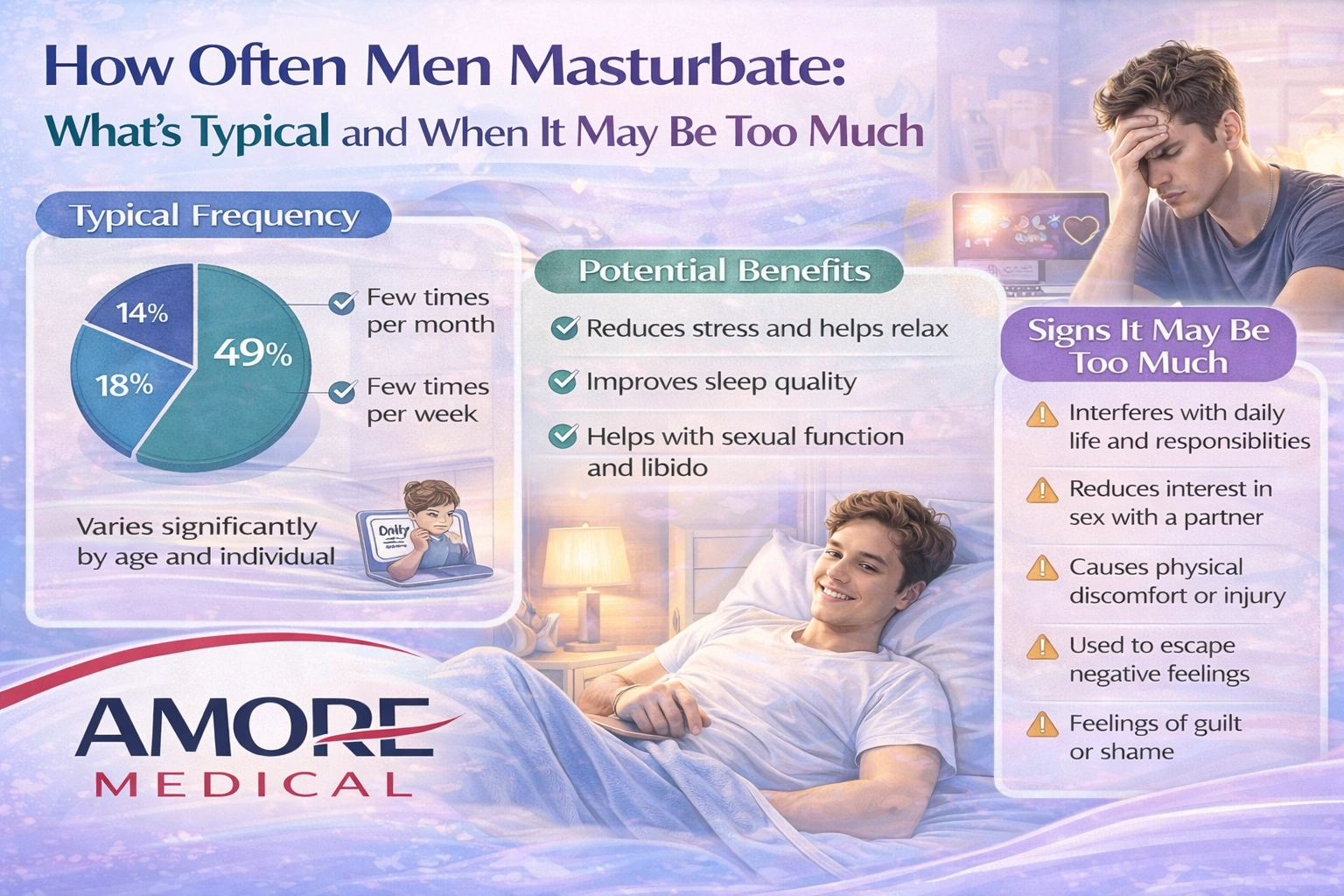
If you have ever wondered how often should men masturbate, you are asking one of the most common questions in sexual health. It is also one of the most misunderstood. Many men assume there must be a “normal” number that tells them whether their habits are healthy, excessive, or somehow a sign that something is wrong. In reality, there is no single magic number that applies to everyone.
That is important to understand from the beginning. Masturbation is a normal part of sexual wellness for many men. Some men masturbate often. Some do it occasionally. Some rarely do it at all. Some never do, and that can be completely normal too. What matters most is not whether your frequency matches someone else’s. What matters is whether it fits your body, your values, your lifestyle, and your overall sexual health without causing distress or interfering with your life.
At Amore Medical, sexual wellness is never reduced to one symptom or one behavior. It is about comfort, confidence, intimacy, and overall well-being. That means questions about masturbation deserve the same honest, practical guidance as questions about erections, hormones, libido, or performance. Men often ask whether masturbation lowers testosterone, harms fertility, causes ED, or becomes unhealthy if it happens daily. Those are fair questions, especially in a world full of misinformation and shame-based advice.
This article explains what is typical, what “too much” actually means, what masturbation can and cannot tell you about your sexual health, and when a pattern may be worth talking through with a clinician. The goal is not to judge the behavior. It is to help you understand it clearly and use that understanding to support healthier, more confident sexual decision-making.
There Is No One “Correct” Frequency
The most useful answer to how often should men masturbate is that there is no medically required frequency. Masturbating every day — or even more than once a day — can be perfectly healthy and safe for some people. That means daily masturbation is not automatically a sexual health problem, a hormonal problem, or a sign that someone is damaging their body.
What is typical varies widely. One man may masturbate a few times a week and feel that it fits naturally into his life. Another may do so daily and feel perfectly fine. Another may go long stretches without any desire to masturbate and still have a healthy sex life. Frequency changes with age, stress, relationship status, libido, sleep, privacy, mood, and overall health. That is one reason a rigid number is not very useful.
When people ask about a “normal” amount, what they often really want to know is whether their behavior is okay. In most cases, if it is not causing problems, guilt, pain, or interference with daily life, it is probably within the range of normal sexual behavior.
Why Men Masturbate in the First Place
Masturbation is often treated like it must mean one thing, but it can serve several purposes. Sometimes it is simply about pleasure. Sometimes it is about stress relief or relaxation. Sometimes it is part of exploring what feels good sexually. Sometimes it happens because libido is high and the body wants release. Sometimes it is used as a sleep aid. None of those reasons automatically make it unhealthy.
Masturbation can have mental and physical benefits, including stress relief, better sleep, mood support, and easing sexual tension. That does not mean masturbation is “required” for wellness. It means it can be a normal and beneficial part of sexual life for many people.
In intimate wellness care, this matters because the same behavior can mean very different things depending on context. A man who masturbates daily because he has a healthy libido and it fits easily into his life is in a very different situation from a man who feels unable to stop even when it is causing distress or interfering with work, sleep, or relationships.
So What Is “Typical” for Men?
There is no one typical frequency that defines healthy male sexual behavior. That may sound repetitive, but it is the most important point in the entire conversation. Some men masturbate a few times a month. Some do it several times a week. Some do it daily. Some go through phases where it happens much more often and other phases where it barely happens at all.
The more useful question is not “How often do other men do it?” but “How is this affecting me?” Frequency by itself does not tell you whether something is healthy. Context does. A pattern that feels fine, does not cause physical irritation, does not make you feel out of control, and does not interfere with responsibilities or partnered intimacy is usually not a problem simply because of the number of times it happens.
This is one of the biggest shifts toward a healthier mindset. Sexual wellness is about fit, not comparison.
When Masturbation May Be Considered “Too Much”
For most men, the issue is not really a specific number. The issue is whether the behavior is creating problems. If you feel guilty or think you may be masturbating too much, it is reasonable to talk with a healthcare provider, especially if the behavior is interfering with your life.
Masturbation may be worth a closer look if it:
- interferes with work, school, sleep, or daily responsibilities,
- causes ongoing physical irritation, pain, or skin injury,
- creates significant guilt or distress,
- feels compulsive or difficult to control,
- gets in the way of partnered intimacy you actually want,
- becomes your main coping strategy for stress, anxiety, or difficult emotions.
Those signs are much more meaningful than whether the behavior happens every day. Daily masturbation is not automatically too much. A lower frequency can still be problematic if it feels compulsive or distressing. Again, context matters more than count.
Daily Masturbation: Is It Bad?
This is one of the biggest myths online. Daily masturbation is not automatically harmful. Where daily masturbation may become less ideal is not because of the number itself, but because of what surrounds it. If it causes soreness, pulls attention away from sleep or responsibilities, or becomes the only way someone knows how to regulate stress, then the conversation changes. But if it feels manageable, does not cause harm, and fits naturally into your life, the fact that it happens daily is not, by itself, a medical concern.
That distinction matters in sexual wellness care because many men have been taught to judge the habit only by frequency. In reality, private intimate health care looks at the bigger picture. A man who masturbates daily and feels physically comfortable, emotionally balanced, and sexually confident is in a very different situation from a man who feels drained, distracted, ashamed, or unable to control the pattern. The behavior may look similar on the surface, but the health context is not the same.
In men’s sexual health, daily masturbation is best understood as a pattern that needs context, not as a red flag by default. Libido varies from person to person. Stress levels vary. Age, relationship status, privacy, work schedule, sleep quality, and hormone patterns can all influence sexual desire and behavior. Because of that, a frequency that feels completely normal for one person may feel excessive or unhelpful for another.
When Daily Masturbation May Be Completely Fine
For many men, daily masturbation is simply one expression of a healthy libido. It may be part of stress relief, relaxation, self-exploration, or a normal sexual routine that does not interfere with life. In restorative sexual wellness, a pattern like this is usually not viewed as a problem if the person still feels in control of it and it is not negatively affecting relationships, work, sleep, or sexual confidence.
Daily masturbation may feel healthy and manageable when:
- it does not cause pain, skin irritation, or genital soreness,
- it is not interfering with work, responsibilities, or sleep,
- it does not create guilt or emotional distress,
- it is not reducing interest in intimacy you actually want,
- it still feels like a choice rather than a compulsion.
That last point is especially important. In intimate medicine, feeling in control of the behavior usually matters more than the frequency itself. A person can masturbate daily and still have a healthy, balanced sexual life if the pattern feels intentional, comfortable, and compatible with the rest of daily life.
When Daily Masturbation May Be Worth Reassessing
There are also times when the issue is not the daily rhythm itself, but what it may be replacing or masking. If masturbation starts becoming the main way a person copes with boredom, anxiety, loneliness, frustration, or emotional discomfort, it may be helpful to pause and look more closely at the pattern. This does not mean the behavior is automatically unhealthy. It means it may be doing more emotional work than it seems to be doing on the surface.
In performance wellness and sexual medicine, these are often the moments when a man realizes the habit feels less like pleasure and more like compulsion, avoidance, or routine escape. That kind of shift is worth taking seriously—not with shame, but with curiosity and honesty.
Signs the Pattern May Be Becoming Less Helpful
A man may want to take a closer look at the habit if daily masturbation is starting to come with signs such as:
- ongoing soreness, redness, or skin irritation,
- difficulty stopping even when he wants to,
- using it mainly to escape stress or difficult emotions,
- feeling distracted by it during work or important tasks,
- losing interest in partnered intimacy that he actually wants,
- feeling shame or frustration after the behavior but repeating the cycle anyway.
These signs do not automatically mean something is seriously wrong. They simply suggest the habit may deserve more attention than the frequency count alone provides. In men’s intimate health, patterns that feel compulsive or emotionally loaded often benefit from a more thoughtful conversation than “Is once a day too much?”
How Daily Masturbation Can Affect Sexual Confidence and Partnered Intimacy
Another reason this topic matters is that some men begin to notice a difference between how their body responds during masturbation and how it responds during partnered intimacy. That does not mean masturbation is “causing damage,” but it can sometimes shape sexual expectations, stimulation patterns, or performance pressure in ways that matter.
For example, if masturbation becomes highly routine, highly specific, or consistently more intense than partnered stimulation, real-life sex may feel different by comparison. In sexual wellness practice, this is often a question of pattern and conditioning rather than injury. The more specific and repetitive the stimulation style becomes, the more helpful it may be to look at whether some variety, less intensity, or more mindful pacing would support better overall sexual responsiveness.
This is especially worth noticing if a man feels that masturbation is easy and dependable, but partnered sex feels pressured, less responsive, or harder to enjoy. That kind of contrast can point to stress, performance anxiety, overstimulation patterns, or a need to better understand how arousal is functioning in different settings.
Why the Emotional Experience Matters Too
In private sexual health care, the emotional response to the behavior matters just as much as the physical one. A man who masturbates daily without distress is usually in a very different place from someone who feels guilty every time, hides the behavior in a way that increases anxiety, or uses it in a cycle of stress and regret. Frequency does not explain those differences. Emotional experience does.
That is why a more useful question is often not “How often is too often?” but “What role is this playing in my life right now?” When men ask that question honestly, they usually get much better answers than they do from generalized internet rules.
When It Makes Sense to Talk With a Clinician
Daily masturbation does not require treatment. But if the pattern is starting to affect comfort, confidence, erections, libido, or emotional well-being, it may be worth discussing with a clinician who understands sexual wellness in a practical, nonjudgmental way. A good conversation can help separate what is normal variation from what may be linked to stress, compulsive behavior, sexual conditioning, pain, hormone changes, or another underlying issue.
At a practice focused on intimate health, that conversation is not about labeling the behavior as “good” or “bad.” It is about understanding whether it is still working for the person—or whether it has started working against his goals for sexual confidence, comfort, and overall well-being.
That is often the most useful frame for daily masturbation. It is not a problem because it is daily. It only becomes a problem if the pattern stops feeling healthy, balanced, or compatible with the life and intimate connection the person actually wants.
Does Masturbation Lower Testosterone?
This is another very common fear, and it is one of the most persistent myths. Frequent masturbation does not have long-term effects on testosterone levels and does not cause low testosterone. That is an important reassurance because many men interpret normal fluctuations in energy, desire, or performance as proof that masturbation has “drained” them hormonally. That is not how testosterone deficiency works.
If a man has symptoms such as persistent low libido, fatigue, reduced muscle mass, depressed mood, or erectile changes, those symptoms deserve a proper hormone evaluation rather than being blamed automatically on masturbation.
In sexual health care, myths about testosterone often distract from the real question. If something feels off, it is better to look at sleep, stress, metabolic health, hormones, medications, and circulation than to assume masturbation itself is the cause.
Does Masturbation Affect Fertility?
Men also often worry that masturbating “too often” will ruin fertility or dramatically weaken sperm. Frequent male masturbation is not likely to have much effect on fertility. While some data suggest optimal semen quality may occur after a short break from ejaculation, men with normal sperm quality can still maintain normal sperm motility and concentrations even with daily ejaculation.
That means masturbation is not generally something men need to fear from a fertility standpoint. However, when someone is actively trying to conceive or preparing for a semen test, timing of ejaculation may matter in a more specific medical way. That is very different from the broader myth that masturbation is inherently bad for fertility.
Can Masturbation Cause Erectile Dysfunction?
This is where the conversation gets more nuanced. Masturbation itself does not directly “cause” erectile dysfunction in the way many fear. But the patterns surrounding it can sometimes affect sexual response. For example, if someone uses a very intense grip, highly specific stimulation, or a very narrow fantasy pattern every time, real-life partnered sex may feel different and less immediately responsive. That does not mean the penis is damaged. It means the body may be getting used to a very specific stimulation style.
There is also the issue of timing. If a man masturbates shortly before partnered sex, he may find it harder to get another erection right away or may take longer to climax because of the normal refractory period. That is not ED. It is normal physiology.
Where the issue becomes more important is if a man notices that masturbation consistently feels easy and satisfying, but partnered sex repeatedly feels difficult, pressured, or disconnected. In that case, the conversation may involve anxiety, performance habits, relationship tension, or sexual conditioning patterns—not damage from masturbation itself.
What If Masturbation Feels Better Than Partnered Sex?
This is more common than many men admit, and it does not necessarily mean something is wrong with the relationship. Masturbation is private, predictable, and under your complete control. Partnered sex is more emotionally complex. It involves communication, timing, connection, performance pressure, and another person’s body and reactions.
If masturbation is consistently easier than partnered sex, it may be a clue worth paying attention to. Sometimes the difference reflects anxiety or pressure. Sometimes it reflects a masturbation style that is very specific and difficult to replicate during sex. Sometimes it reflects lower desire for the partner, unresolved relationship stress, or simple fatigue.
In sexual wellness care, this is not a reason for shame. It is a reason to ask better questions about what kind of stimulation, emotional setting, and mental state help the body respond best.
When the Pattern May Be More About Stress or Compulsion
For some men, masturbation is less about pleasure and more about emotional regulation. It may become the first response to boredom, stress, loneliness, frustration, or anxiety. Again, that does not automatically make it unhealthy. But if it starts feeling compulsive—like something you are doing to escape feelings rather than because you actually want the sexual experience—it may be worth looking at more closely.
Signs that the pattern may need more attention include:
- feeling unable to cut back even when you want to,
- using it repeatedly to avoid emotions or difficult tasks,
- feeling significant shame afterward but repeating the cycle,
- neglecting responsibilities or relationships because of it,
- needing more and more time, stimulation, or pornography to feel satisfied.
In those situations, the issue is not moral failure. It may be that a sexual behavior has become tangled up with anxiety, avoidance, or compulsive habits. That is something a therapist, sexual health clinician, or counselor can help untangle in a practical and nonjudgmental way.
Physical Signs That You May Need to Slow Down
Most masturbation is physically safe, but too much friction, pressure, or intensity can cause soreness or irritation. If you notice redness, tenderness, skin abrasions, swelling, or pain, that is a sign to pause and let the tissue recover. The issue is usually not the act itself. It is usually the intensity, dryness, or frequency without enough recovery.
Using lubrication, reducing force, varying technique, and allowing time to heal can help. If pain persists, or if there is bleeding, curvature change, or signs of injury, that should not be ignored. At that point, it makes sense to be medically evaluated rather than assuming it will always resolve on its own.
How to Think About “Healthy” Masturbation
Healthy masturbation is not about following a perfect rule. It is about whether the behavior fits well within your life and supports your sexual wellness rather than working against it. A healthy pattern usually feels consensual with yourself, manageable, physically comfortable, and not disruptive to the parts of life that matter to you.
That may look different from one person to another. For one man, healthy means a few times a week with no real emotional baggage. For another, it may be daily but relaxed and harmless. For another, it may be rare or not part of life at all. There is room for all of those patterns in normal male sexual health.
When to Consider Talking to a Clinician
You do not need a medical appointment simply because you masturbate often. But it may be worth talking to a clinician if:
- you feel the behavior is out of control,
- it is causing guilt, distress, or relationship strain,
- you have pain, irritation, or injury,
- you are worried about erections, libido, or orgasm changes,
- you are using masturbation in a way that feels compulsive rather than satisfying,
- you want help figuring out whether the issue is sexual, hormonal, emotional, or relational.
At Amore Medical, these conversations are treated as part of legitimate sexual wellness care. Men often assume they should only seek help for major problems like erectile dysfunction or low testosterone. But questions about masturbation, libido, arousal, confidence, and sexual habits are part of the same health picture.
What This Means at Amore Medical
At Amore Medical, the question how often should men masturbate is not answered with a rigid number. It is answered by looking at the whole person. Masturbation is often a normal, healthy part of sexual life. It does not inherently lower testosterone, ruin fertility, or cause long-term damage. But like any sexual behavior, it can become less helpful if it causes distress, physical discomfort, or interferes with intimacy, daily life, or emotional well-being.
The goal is not to shame the behavior or to endorse it blindly. The goal is to help men understand their bodies more clearly, reduce unnecessary fear, and recognize when a pattern deserves more support. In sexual wellness care, clarity is often more powerful than rules. Once men understand that there is no single “correct” amount, they can shift the question from “Am I normal?” to “Is this working well for me?”
That is usually where healthier answers begin.