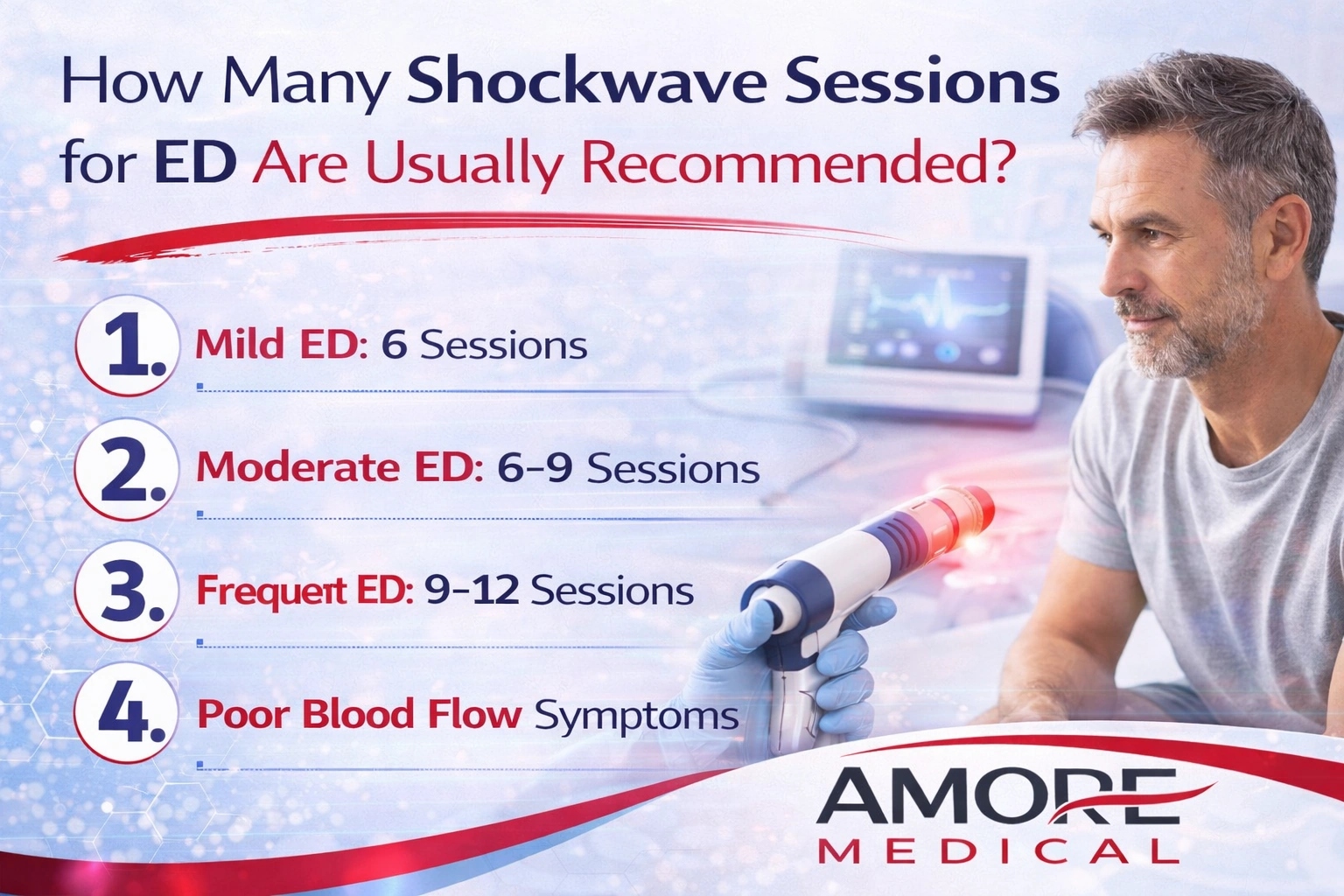
If you have been searching can shockwave therapy help ED, you are probably looking for something more useful than a sales pitch. You want to know whether this treatment is actually promising, who it may help, and what kind of result is realistic. That is exactly the right way to approach it. Erectile dysfunction can feel deeply personal, but treatment decisions should still be grounded in evidence, candidacy, and clear expectations.
At Amore Medical, the conversation around erectile dysfunction is not limited to short-term performance. It is about sexual confidence, intimacy, and quality of life. Many men who ask about shockwave therapy are not only looking for a stronger erection tonight. They are looking for a non-surgical option that may fit into a broader plan for sexual wellness. That is why focused shockwave therapy has become such an important part of the discussion in modern men’s sexual health care.
The short answer is that shockwave therapy may help some men with erectile dysfunction, especially when the problem appears to be related to blood flow. But that answer needs context. It is not a universal fix, and it should not be presented as though every man with ED will respond the same way. The strongest evidence so far points toward men with mild-to-moderate vasculogenic erectile dysfunction, meaning ED that is strongly tied to circulation. In those men, shockwave therapy may improve erectile function and erection hardness. In other men, the treatment may be less relevant or may need to be part of a larger plan rather than used as a stand-alone answer.
This article explains how shockwave therapy fits into the ED treatment landscape, what current evidence suggests, why patient selection matters so much, what results men should realistically expect, and how this treatment compares with more familiar options like oral medication. The goal is not hype. It is clarity.
Why Erectile Dysfunction Is Not One Single Problem
One reason ED treatment gets confusing is that people talk about erectile dysfunction as if it were one disease with one cause. In real life, it is much more complex. Erections depend on healthy blood flow, nerve signaling, hormone balance, sexual stimulation, and mental ease. If any one of those systems is under strain, erections may become less reliable. If several of them are involved at once, the problem can feel even more frustrating.
That is why some men have ED mainly because of vascular issues, while others are dealing more with low testosterone, anxiety, medication side effects, relationship stress, diabetes, poor sleep, or a mixed picture. This difference matters because a treatment that may help one type of ED may be much less helpful for another.
Shockwave therapy enters the conversation most naturally when ED appears to have a vascular component. That means the first question is not simply, “Does shockwave therapy work?” The better question is, “Does my ED seem like the kind that shockwave therapy is most likely to help?”
Why Blood Flow Is Central to Better Erections
An erection is fundamentally a blood flow event. During sexual arousal, blood vessels in the penis widen, blood moves into the erectile tissue, and pressure builds enough to create firmness. If the blood vessels are narrowed, stiff, inflamed, or simply not functioning well, the penis may not fill the way it needs to. That can show up as softer erections, delayed erections, erections that fade too soon, or inconsistent performance that becomes more noticeable over time.
This is why vascular erectile dysfunction is so common in men with high blood pressure, high cholesterol, diabetes, smoking history, obesity, or other cardiovascular risk factors. It is also why ED is sometimes one of the earliest noticeable signs that broader vascular health deserves attention. When blood vessels are under strain, erections may show it before something more dramatic appears elsewhere.
For many men, this is an important shift in perspective. ED is not always just about age or confidence. Sometimes it is also about circulation. Once that becomes clear, a non-invasive treatment aimed at blood-flow-related ED makes much more sense as part of the conversation.
What Shockwave Therapy for ED Actually Is
Shockwave therapy for erectile dysfunction usually refers to low-intensity extracorporeal shock wave therapy. It is an office-based treatment that uses targeted acoustic energy delivered to penile tissue. It is not surgery. It is not an implant. It is not a medication taken before sex. That alone makes it appealing to many men who want to explore an option that feels less invasive and less tied to moment-by-moment timing.
The reason the treatment has drawn so much interest is that it is discussed as a non-surgical option that may support erectile function over time in selected men. In other words, the appeal is not just that it may help with erections. It is that it may fit men who want to move beyond a pill-only approach and explore something that feels more restorative in concept.
That said, it is still a medical treatment, not a magic solution. It works best when it is offered to the right patient for the right reason. That is exactly where evaluation matters.
What the Current Evidence Actually Suggests
The current evidence on shockwave therapy for ED is promising, but not completely settled. That is the most honest way to say it. A number of clinical studies, reviews, and meta-analyses suggest that low-intensity shockwave therapy may improve erectile function and erection hardness in men with vasculogenic ED, particularly those with mild-to-moderate symptoms. This is why the treatment continues to gain traction in sexual medicine and why more patients are asking about it.
At the same time, the research has real limitations. Studies vary in patient selection, device type, treatment settings, number of sessions, energy levels, and follow-up. That makes the results harder to interpret cleanly than many clinic websites imply. A recent 2025 Cochrane review concluded that the evidence base is still evolving, that many studies are of poor methodological quality, and that it remains unclear whether the treatment truly helps men with ED in a definitive way. That is not a dismissal of shockwave therapy. It is a reminder that promising evidence and definitive evidence are not the same thing.
On the more encouraging side, a 2024 umbrella review of five systematic reviews and meta-analyses found that low-intensity shockwave therapy, compared with placebo, may improve erectile function and erection hardness in men with mild-to-moderate vasculogenic ED. That is a meaningful signal. It tells us the treatment deserves serious attention, especially in a properly selected patient population. But it still does not support careless overpromising. ([pmc.ncbi.nlm.nih.gov](https://pmc.ncbi.nlm.nih.gov/articles/PMC10890328/))
Why Guideline Language Matters
One of the most useful ways to understand how strong the evidence is right now is to look at how professional societies describe the treatment. That is where the current nuance becomes especially clear.
The European Association of Urology says that low-intensity shockwave therapy may induce a mild improvement in erectile function among men with vasculogenic ED. That wording is measured, realistic, and clinically helpful. It supports the idea that the therapy may help selected men, but it keeps expectations grounded by emphasizing mild improvement rather than dramatic restoration for everyone.
The American Urological Association remains more conservative and continues to classify shockwave therapy for ED as investigational. That means the AUA does not yet consider it established routine care in the same way it considers more standard ED treatments.
These two positions are not as contradictory as they may seem. Both acknowledge that the treatment shows promise. The real difference is how strong they believe the evidence is right now. That is why any credible clinic should discuss shockwave therapy with optimism, but also with restraint.
Who May Benefit the Most
Based on current evidence, the men most likely to benefit are those with mild-to-moderate vasculogenic erectile dysfunction. These are often men who still have some erectile function, but not the consistency, rigidity, or reliability they want. Erections may still happen, but they may not be firm enough, last long enough, or feel dependable enough for satisfying sex.
These men often fit a pattern like this:
- erections have declined gradually rather than disappearing suddenly,
- there are known vascular or metabolic risk factors such as high blood pressure, diabetes, or cholesterol issues,
- there is still some response to arousal, but not at the level the patient wants,
- the patient wants to explore a non-surgical option and is open to an office-based treatment plan.
This does not mean every man with those features will respond identically. It means those are the kinds of patients most often represented in the literature and most often discussed as reasonable candidates.
Who May Need a Different First Step
Shockwave therapy is not the best first move for every patient who dislikes ED medication or wants something more advanced. Some men need a different conversation before they need acoustic treatment. If a man’s symptoms strongly suggest low testosterone, major stress, performance anxiety, medication-related ED, or a deeper relationship issue, then the first step may be hormone evaluation, medication review, counseling, or a broader sexual health assessment.
This is one reason Amore Medical’s approach matters. Sexual wellness care works best when it is personalized. A man may be highly interested in shockwave therapy, but if the root cause of his symptoms is not primarily vascular, then the treatment may not be the smartest place to begin. The goal is not to force every patient into the same solution. It is to match the treatment to the person.
What Results Men Should Realistically Expect
Healthy expectations are one of the most important parts of a successful treatment experience. Men considering shockwave therapy should think in terms of improvement, not guaranteed transformation. For the right patient, improvement may mean better erection quality, firmer response, more consistency, greater spontaneity, or less dependence on other aids. In real life, that kind of progress can make a major difference in confidence and intimacy.
But the most responsible expectation is still not “this will make everything perfect.” It is “this may help if I am a good candidate, and the degree of help depends on my specific situation.” That is one reason the EAU’s phrasing of mild improvement is so useful. Even a mild-to-moderate gain can feel meaningful to a man whose erections have become less dependable. At the same time, the treatment should not be sold as if every patient will return to the best sexual function of his life.
When clinics set realistic expectations, patients tend to feel better served even when results are gradual. Honesty makes the treatment journey easier, not harder.
How Shockwave Therapy Compares With ED Medication
For many men, the real decision is not whether shockwave therapy sounds promising. It is whether it makes more sense than an ED pill. Oral PDE5 inhibitors such as sildenafil and tadalafil remain standard first-line options because they are well studied, widely used, and often effective at improving penile blood flow during sexual stimulation.
That gives ED medication a different role. Pills are usually the more direct, immediate, symptom-focused option. Shockwave therapy, by contrast, is usually discussed as a non-surgical office-based treatment that may support erectile function over time in selected men.
This means the better question is not “which one is better overall?” It is “which one fits my goals?” If your main goal is immediate support for erections and you are comfortable with medication, pills may still be the most logical first step. If your main goal is to explore a non-surgical approach because you want something beyond pill-only care and your symptoms strongly suggest a vascular pattern, shockwave therapy may deserve serious discussion.
In some cases, men may consider both within a broader treatment plan. That is not a contradiction. It is simply what personalized sexual medicine often looks like.
Why Lifestyle Still Matters No Matter What
One of the biggest mistakes in ED care is treating any one therapy as though it replaces vascular health. If the problem is related to blood flow, then the same habits that affect your cardiovascular system also affect your erections. NIDDK notes that lifestyle changes can help improve ED symptoms, including stopping smoking, increasing physical activity, maintaining a healthy weight, and improving overall health habits.
This matters because men often get the best long-term outcomes when treatment is layered. A man who improves sleep, exercise, blood pressure, weight, and metabolic health gives every ED therapy a better chance to help. A man who ignores all of those issues may still pursue treatment, but he is doing so while the underlying drivers of vascular strain continue in the background.
In other words, shockwave therapy may be an important part of care, but it is not a substitute for circulation-friendly living.
Questions to Ask Before Starting Treatment
If you are seriously considering shockwave therapy, ask questions that go beyond excitement and get into fit. Useful questions include:
- Does my symptom pattern sound like vasculogenic ED?
- What kind of improvement is realistic for me?
- How is progress measured?
- What happens if my response is only partial?
- Should this be combined with medication, lifestyle work, or other care?
- Why do you believe this treatment fits my case specifically?
A strong sexual wellness provider should be able to answer these calmly and clearly. That is part of what separates trustworthy care from generic sales language.
How This Fits Into Sexual Wellness at Amore Medical
At Amore Medical, focused shockwave therapy fits naturally into a broader intimate wellness model because it offers a non-surgical option for men who may be good vascular ED candidates and who want to explore more than a pill-only approach. That does not mean it is automatically right for everyone. It means the treatment is valuable when it is used thoughtfully, in the right patient, with honest expectation-setting and a broader plan for sexual health.
For some men, that plan may include medication. For others, it may include hormone evaluation, lifestyle work, or counseling alongside office-based treatment. What matters most is that the care is not generic. It is designed around the patient’s symptoms, goals, and overall sexual confidence.
So, can shockwave therapy help ED? For the right man, yes, it may. The strongest current evidence suggests it may benefit selected men with mild-to-moderate vasculogenic ED. The most important step is not chasing the treatment blindly. It is making sure the treatment fits the real cause of the problem and the kind of outcome you want.