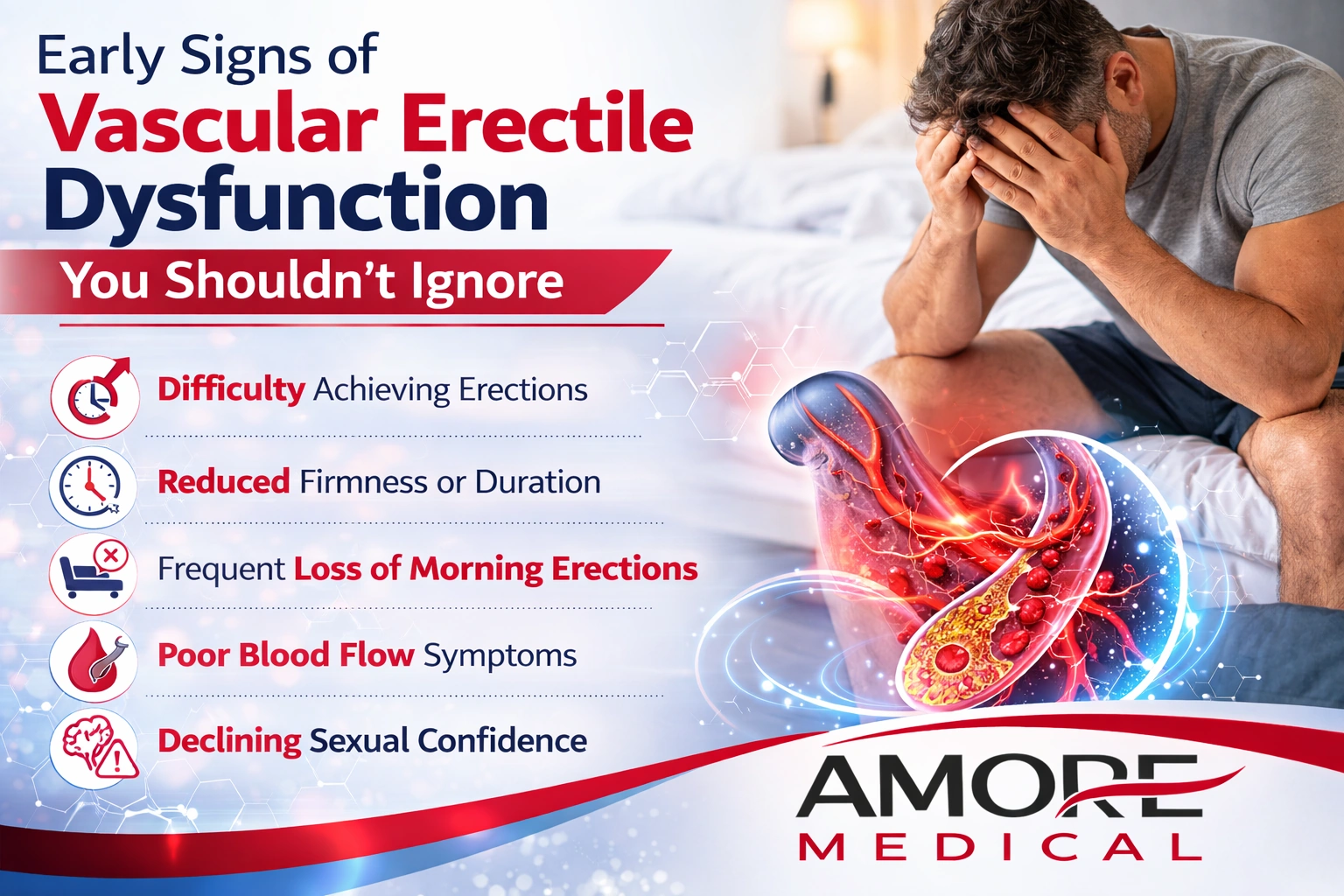
Many men do not think of erectile function as a circulation issue until erections start changing in ways that are hard to ignore. At first, the shift may feel subtle. Erections may still happen, but they do not feel as firm as they used to. They may take longer to build, fade more quickly, or feel less reliable during sex. Because these changes can happen gradually, it is easy to dismiss them as stress, aging, or a temporary slump. But in some cases, those changes are among the early signs of vascular erectile dysfunction.
That distinction matters. Erectile dysfunction is not always only about desire, confidence, or performance. For many men, erections depend on one very physical factor: healthy blood flow. If the blood vessels are not widening the way they should, or if blood is not staying in the penis effectively enough to maintain firmness, erectile quality often changes before a man realizes something bigger may be going on.
This is one reason sexual wellness care is about more than restoring function in the bedroom. Vascular erectile dysfunction can sometimes be one of the earliest visible signs that blood vessel health deserves more attention. The same conditions that affect circulation elsewhere in the body can also affect erections. That does not mean every erection problem points to a serious cardiovascular condition. It does mean recurring changes should not always be brushed aside.
At Amore Medical, sexual health is approached as part of whole-person wellness. Confidence, intimacy, blood flow, hormones, stress, and overall health all influence sexual function. This article explains the early signs of vascular erectile dysfunction, why those signs matter, what may be causing them, and when symptoms suggest it is time for medical evaluation instead of more waiting.
What Vascular Erectile Dysfunction Actually Means
Vascular erectile dysfunction is ED that is primarily related to blood vessel function and circulation. An erection depends on blood moving into the penis efficiently and staying there long enough to create firmness. When blood flow is reduced or the blood vessels are not responding well, erections may become weaker, less dependable, or harder to maintain.
This kind of ED often develops gradually rather than all at once. That is one reason it gets missed. A man may not suddenly lose erections completely. Instead, he notices that things feel different. He may still be able to have sex sometimes, but he no longer feels he can count on his body in the same way. That inconsistency is often where the emotional strain begins. Uncertainty leads to overthinking, and overthinking can make the physical problem feel even worse.
Understanding vascular ED helps remove some of the confusion and shame. It reminds men that erectile changes are not always a character flaw, a relationship failure, or proof that desire is gone. Sometimes they are a signal that circulation is not working as smoothly as it once did.
Why Blood Flow Matters So Much for Erections
An erection is, in very practical terms, a blood flow event. During sexual arousal, the blood vessels in the penis need to relax and widen so blood can move into the erectile tissue. Once enough blood enters, pressure builds and the penis becomes firm. If that inflow is weaker than it should be, or if blood does not stay trapped effectively enough, erection quality suffers.
That is why the early stages of vascular ED can feel frustratingly inconsistent. A man may still get partially hard, but not as fully as before. He may lose firmness during intercourse. He may feel that erections are “good enough sometimes,” but not strong enough to feel confident. Those are not random changes. They are often signs that circulation deserves a closer look.
Because penile blood vessels are relatively small, vascular problems may become noticeable there before symptoms show up elsewhere in the body. In some men, ED becomes a warning sign earlier than chest pain or another more obvious cardiovascular symptom. That connection is one reason medical professionals take erectile changes seriously, especially when risk factors for vascular disease are also present.
The Earliest Signs Men Often Notice First
The early signs of vascular erectile dysfunction are often easy to minimize because they do not always look dramatic at first. Many men still have erections. The difference is that the erections are not as dependable, as firm, or as sustainable as they used to be.
Some of the most common early patterns include:
- erections that are softer than usual,
- difficulty maintaining firmness long enough for satisfying sex,
- erections that fade when changing positions or during penetration,
- needing more stimulation than before to get fully hard,
- fewer spontaneous or morning erections,
- a gradual decline rather than a sudden complete loss.
These signs matter because men often wait for a more dramatic failure before taking them seriously. But vascular ED usually does not begin as a complete shutdown. It often starts as reduced quality and reliability. That is why noticing patterns early is so valuable.
Softer Erections Are One of the Biggest Clues
One of the first changes many men notice is that erections simply do not feel as strong. They may still be able to have sex, but the firmness is lower than it used to be, and the body feels less responsive. This is often shrugged off as tiredness or age, but softer erections can be one of the clearest early clues that blood flow is not as robust as before.
That does not mean a single softer erection proves anything. Sexual response naturally fluctuates. Stress, alcohol, poor sleep, distractions, and relationship tension can all affect firmness on any given day. What deserves more attention is the pattern. If softer erections are happening repeatedly, especially over weeks or months, they are worth taking seriously.
Losing Erections More Easily Than Before
Another common early sign is losing an erection more easily once it starts. A man may get hard during foreplay but lose firmness before penetration or during intercourse. He may notice that the erection disappears more quickly if he pauses, changes position, or gets distracted for even a moment.
This is one of the most frustrating patterns because it often creates immediate performance anxiety. The man begins monitoring himself closely, worrying that the erection will fade, and that pressure can make the situation even harder. But before it becomes only an anxiety story, it is worth asking whether there is also a vascular component. If the penis is not maintaining enough blood pressure internally, the erection may be much more vulnerable to disruption.
Fewer Morning or Spontaneous Erections
Changes in morning erections can also offer useful information. Men are often reassured when they still wake with erections because it suggests the body can still respond normally under some conditions. By contrast, when morning erections become noticeably less frequent or less firm, that can be a clue that the issue is not purely situational.
Morning erections are not a perfect diagnostic tool, and their absence does not automatically prove vascular ED. But in the broader picture, a clear decline in spontaneous erections can be one of the signs that erectile function is changing at a more physical level. If it appears alongside softer erections, weaker rigidity, or more trouble maintaining firmness, it becomes even more relevant.
When “It’s Probably Just Stress” Stops Being a Good Explanation
Stress absolutely can affect erections. So can fatigue, conflict, poor sleep, and emotional overload. But there comes a point where “it’s probably just stress” stops being a useful explanation and becomes a way of delaying care. If erection problems are recurring, gradually worsening, or starting to show up even when you do not feel especially anxious, it makes sense to think beyond stress alone.
This is especially true if you have other vascular risk factors. Men with high blood pressure, high cholesterol, diabetes, obesity, smoking history, or sedentary habits are more likely to experience blood-flow-related ED. When those risk factors are present, erection changes deserve more attention as a possible circulatory issue rather than just a rough patch.
Health Conditions That Often Travel With Vascular ED
The same underlying issues that affect blood vessels elsewhere in the body can affect erections. Common risk factors and related conditions include:
- high blood pressure,
- high cholesterol,
- diabetes,
- smoking,
- obesity,
- poor physical activity,
- heart disease or broader cardiovascular risk.
These do not just matter because they increase the chance of ED. They matter because they can damage the inner lining of blood vessels and reduce how well circulation responds throughout the body. As those blood vessels become less healthy, erections often become less dependable too. Mayo Clinic notes that erectile dysfunction can be an early warning sign of heart disease because the same process that affects the heart can also affect blood flow to the penis, often earlier.
When Symptoms Suggest It Is Time for Medical Evaluation
A medical evaluation makes sense when the problem is no longer occasional, when it is gradually getting worse, or when it is affecting confidence and intimacy enough that it is changing your behavior. Men do not need to wait for complete erectile failure before seeking help. In fact, earlier evaluation is often more useful because it can identify whether blood flow, hormones, stress, medication effects, or a mix of issues are involved.
It is especially worth scheduling an evaluation if:
- soft or inconsistent erections have become a recurring pattern,
- you are losing erections more often during sex,
- morning erections are noticeably less frequent,
- you have diabetes, high blood pressure, high cholesterol, or a smoking history,
- you are beginning to avoid intimacy because of the issue,
- you suspect medication or hormonal symptoms may also be involved.
These symptoms do not automatically mean something severe is happening, but they are enough to justify more than guessing. An evaluation can clarify whether you are dealing with vascular ED, another physical cause, a stress-related pattern, or a combination of factors.
What Evaluation Usually Looks Like
A good evaluation does not start with assumptions. It starts with the story. A provider will want to know how long the issue has been happening, whether the change was gradual or sudden, whether desire has changed too, whether there are morning erections, and whether certain situations are better or worse than others. Medications, sleep, alcohol use, mental stress, blood pressure, cardiovascular history, and metabolic health all matter.
Depending on the pattern of symptoms, evaluation may also include blood pressure review, laboratory testing, hormone assessment, and broader cardiovascular risk discussion. This is important because ED can be caused by more than one thing at a time. A man may have a vascular pattern plus performance anxiety. Another may have diabetes-related vascular changes plus low testosterone symptoms. The more clearly those pieces are identified, the more precise the treatment plan becomes.
Why Acting Early Can Make a Difference
One reason the early signs of vascular erectile dysfunction should not be ignored is that early action often creates more options. If the issue is recognized while function is declining but not completely lost, men may respond well to lifestyle changes, medication, counseling, or non-invasive office-based treatments depending on the cause. Waiting until the problem feels severe often makes the emotional burden heavier and the treatment conversation more complicated.
That matters in sexual medicine because erectile function usually does not disappear overnight. For many men, the body gives quieter signals first. Erections may still happen, but they may be less firm, less reliable, or more affected by stress, position changes, or timing. Those early shifts are often the moment when intimate wellness care can be most useful. Instead of waiting until frustration builds into avoidance, men have a chance to understand what may be changing and why.
Early care also matters because vascular erectile dysfunction is not only about sex. Blood flow issues that affect erections may overlap with broader circulation concerns, metabolic health, blood pressure, or lifestyle patterns. In men’s vitality care, this is one of the biggest reasons providers encourage men not to brush off recurring ED symptoms. The concern is not simply performance. The concern is that the body may be signaling something worth evaluating before it becomes a bigger problem.
Earlier Care Often Means More Flexible Treatment Choices
When ED is addressed early, treatment planning tends to feel more open and more personalized. A man who still has partial erectile function often has more non-invasive paths to explore than a man who has spent years watching symptoms worsen without support. This is one reason private intimate health care can feel so valuable. It creates room to act while there are still multiple ways to help improve function, confidence, and quality of life.
In restorative wellness and performance-focused sexual health care, earlier treatment may allow space for options such as:
- circulation-supportive lifestyle changes,
- medication when appropriate,
- hormone evaluation if symptoms suggest imbalance,
- counseling or stress-related support when anxiety is part of the pattern,
- non-invasive office-based therapies for selected patients.
That does not mean every man needs every option. It means that early evaluation usually makes it easier to build a plan that matches the actual cause instead of reacting only after confidence has already been heavily affected.
Why Waiting Often Makes the Experience Harder
Many men wait because they hope the problem will pass, or because they do not want to admit that something has changed. That reaction is understandable, but it often makes the situation heavier emotionally. Once erections become unreliable, many men begin monitoring themselves during intimacy. They start anticipating failure, feeling embarrassed, or pulling away from closeness altogether. In sexual wellness care, that emotional layer matters just as much as the physical one because anxiety can make a circulation-related problem feel even more difficult to manage.
The longer that cycle continues, the more likely it is to affect self-esteem and relationship ease. A man may still want intimacy, but not want to risk the disappointment that comes with uncertainty. That can create distance, frustration, and silence in relationships. By the time he finally seeks help, he may be dealing not only with vascular ED, but also with the mental strain that built around it over time.
This is why early support can make such a difference. It does not only protect treatment options. It also protects confidence. When men understand that erection changes may have a real physical basis, many feel immediate relief. The issue stops feeling like a personal failure and starts feeling like something that can be assessed and addressed.
Small Symptoms Are Still Worth Mentioning
One of the most common mistakes in intimate medicine is assuming that symptoms only matter when they become severe. In reality, smaller changes often deserve attention precisely because they are early. Softer erections, reduced morning erections, weaker stamina during intimacy, or erections that fade more quickly than before may sound minor on paper, but in men’s sexual health they can be important clues.
Those changes do not always mean something serious is happening. But they do mean the body may be moving away from its usual baseline. The earlier that change is understood, the easier it becomes to decide whether the best next step is a circulation-focused plan, a hormone workup, a medication review, or another form of intimate wellness support.
What Early Evaluation Can Clarify
Another reason early action helps is that it creates clarity. A man may assume the problem is only stress when it is actually more vascular. Another may assume it is blood flow when it is really medication-related or mixed with sleep deprivation, anxiety, or hormone changes. Without evaluation, all of those possibilities blur together. With evaluation, the treatment conversation becomes much more specific.
In a private sexual health setting, early evaluation can help answer practical questions such as:
- Does this pattern sound vascular, hormonal, emotional, or mixed?
- Are blood pressure, glucose, cholesterol, or circulation concerns part of the picture?
- Could current medications be contributing?
- Would non-invasive treatment options make sense now?
- Is the issue affecting confidence enough that broader support should be included too?
That kind of clarity is often the turning point. Men stop guessing, stop blaming themselves, and start making decisions based on what is actually happening in their bodies.
Why This Matters in a Sexual Wellness Practice
At a practice focused on intimate wellness, acting early is about more than stopping a symptom from worsening. It is about preserving sexual confidence, relationship comfort, and quality of life. When erectile changes are recognized early, treatment can be more proactive, more tailored, and often less emotionally loaded. Patients feel that they are stepping into care while they still have choices, not only after the problem has become severe enough to force the issue.
This is especially important for Amore Medical’s style of care. The goal is not simply to treat ED once it becomes disruptive enough to no longer ignore. The goal is to help patients understand what their bodies may be signaling, explore non-invasive and evidence-based solutions, and move toward stronger function and better confidence before frustration becomes the defining part of their intimate life.
In practical terms, that is why early attention matters. It keeps the conversation focused on possibility instead of damage control. And in sexual wellness care, that shift can change everything about how a patient experiences treatment.
Acting early also matters because erectile dysfunction can be a marker of underlying cardiovascular risk. Addressing blood pressure, glucose, cholesterol, smoking, weight, and physical activity may improve more than sexual function. It may support overall health at the same time. That makes ED one of the few symptoms that can improve intimacy and encourage better preventive care if it is taken seriously instead of ignored.
Where Treatment May Go After Evaluation
Treatment for vascular ED depends on the cause and the goals of the patient. For some men, lifestyle improvements are an essential part of the plan because blood vessel health is central to the problem. For others, oral ED medication may be the first practical step. NIDDK notes that treatment may include lifestyle changes, counseling, and ED medicines. For selected men with vasculogenic ED, non-invasive office-based treatments such as low-intensity shockwave therapy may also become part of the conversation, although the evidence is still developing and major guideline groups remain cautious in how they describe it.
The right plan is not always the most aggressive one. It is the one that fits the actual reason erections have changed. That is why evaluation matters so much more than internet guessing or self-diagnosis.
Why This Matters at Amore Medical
At Amore Medical, erectile dysfunction is not treated as just a performance issue. It is treated as a sexual wellness issue that can affect confidence, relationships, and overall well-being. When men understand that changes in erection quality may be among the early signs of vascular erectile dysfunction, they often feel less shame and more urgency to get real answers.
That shift matters. It turns the conversation away from blame and toward clarity. It creates space to ask better questions, evaluate the true pattern, and explore treatment that supports both sexual function and broader health. For some men, the most important first step is not a procedure or a pill. It is simply recognizing that the body may be signaling something worth paying attention to.