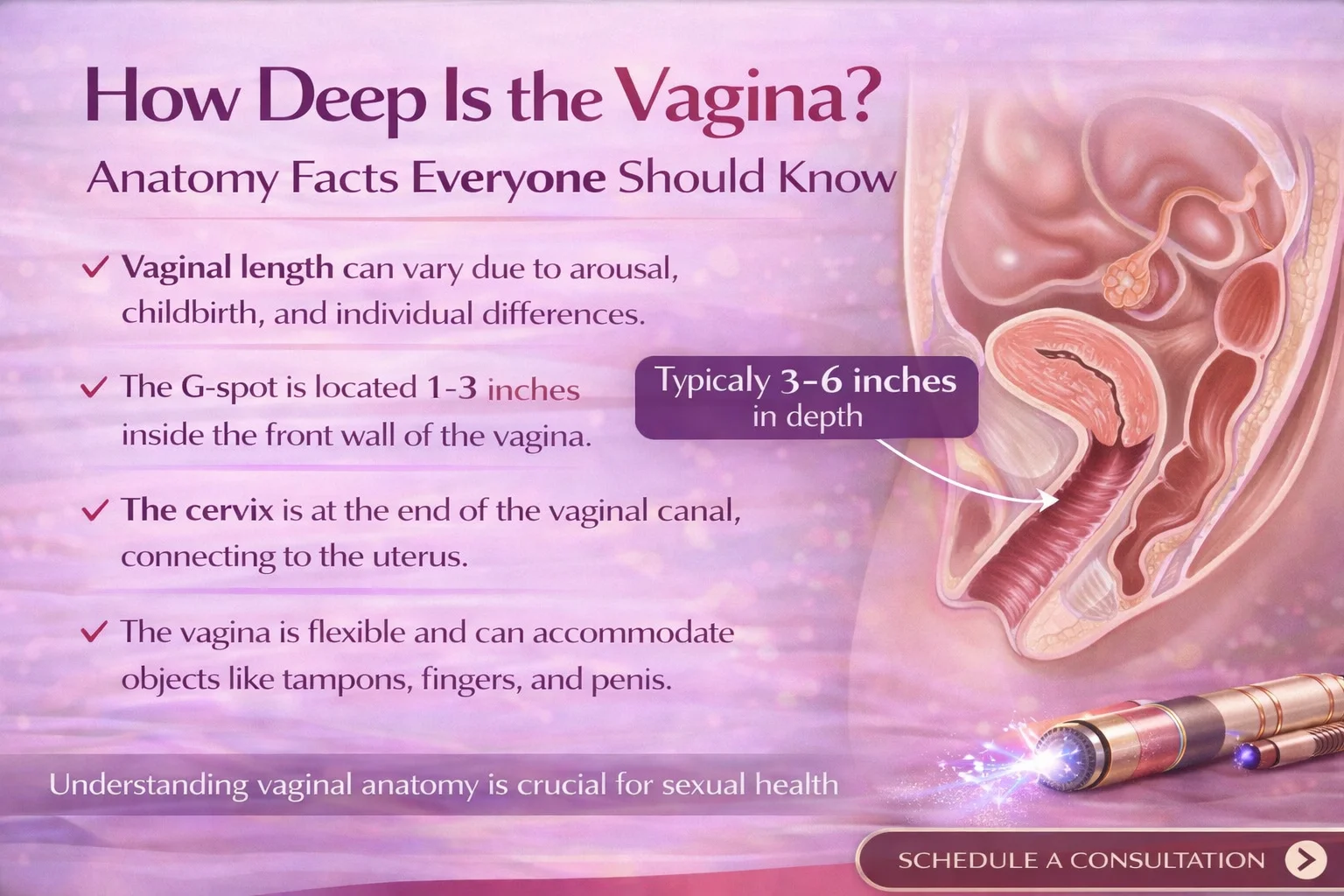
If you have ever wondered how deep is a vagina, you are not alone. It is one of the most common anatomy questions people ask, and it usually comes from a mix of curiosity, confusion, and comparison. Some people want to understand what is normal. Others are trying to make sense of sex, comfort, tampon use, pelvic exams, or body image. And some are simply trying to separate myth from fact after hearing too many exaggerated claims online.
The good news is that vaginal anatomy is easier to understand than most people think. The better news is that the answer is not just one number. The vagina is not a rigid tube with a fixed depth that stays the same in every situation. It is a muscular, flexible canal that changes with arousal, age, hormones, childbirth, and individual anatomy. That is why a short, simplistic answer often creates more confusion than clarity.
For a sexual wellness audience, this topic matters for more than anatomy trivia. Understanding the vagina better can improve comfort, communication, and body confidence. It can also reduce unnecessary worries about size, penetration, pain, and whether something is “normal.” In many cases, the most helpful thing a person can learn is that variation is expected and that comfort matters much more than trying to match an unrealistic idea of what bodies are “supposed” to be.
This article takes a practical, reassuring approach to the question how deep is a vagina. We will look at what the vagina actually is, how its depth changes with arousal, what the cervix has to do with vaginal depth, common myths about size and penetration, and when discomfort may be worth discussing with a clinician. The goal is not to make anatomy feel clinical or intimidating. It is to make it easier to understand your body and talk about it with more confidence.
What the Vagina Actually Is
One reason this topic gets confusing is that many people use the words vagina and vulva as if they mean the same thing. They do not. The vulva is the external genital area, including the labia, clitoral hood, and vaginal opening. The vagina is the internal muscular canal that connects the vaginal opening to the cervix. It is part of the reproductive tract and serves multiple functions, including allowing menstrual blood to exit the body, creating a passage for penetrative sex, and serving as the birth canal during childbirth.
This distinction matters because a lot of body questions are really about the vulva, not the vagina. But when people ask how deep is a vagina, they are usually talking about the internal canal itself. That canal is not a straight, open tunnel waiting in one fixed shape all the time. It is more flexible and dynamic than that.
The vagina is made of muscular tissue and a lining that can stretch and accommodate changes. That flexibility is one of its most important anatomical features. It is also one reason why a single number never tells the whole story.
So, How Deep Is the Vagina?
In an unaroused state, the vagina is often described as being around 3 to 4 inches deep. That is a helpful starting point, but it should not be treated like an absolute rule for every person. Bodies vary. Some vaginas may be a little shorter, some a little longer, and both can still be completely normal.
What matters just as much is that the vagina can lengthen and expand with arousal. As blood flow increases and the body becomes more sexually responsive, the vaginal canal stretches, and the cervix lifts slightly higher. This makes more room for penetration and is one reason arousal is so important for comfort during sex. A body that is not fully aroused may feel tighter, less lubricated, and less comfortable with penetration, while a body that has had time to become aroused is often more relaxed, better lubricated, and more accommodating.
This is one of the most important facts people miss. Vaginal depth is not static. It changes with the body’s state. That is why asking only for a number can be misleading. Anatomy is real, but physiology matters too.
Why the Vagina Feels Different at Different Times
If the vagina can stretch and change, then it makes sense that it may feel different at different times. Hormones, arousal, stress, age, and childbirth can all influence how the vagina feels and functions. Some of these changes are temporary. Some are more long-term. None of them automatically mean something is wrong.
During sexual arousal, several things happen at once. Lubrication increases, tissues become more engorged with blood, and the vaginal canal lengthens somewhat as the uterus and cervix lift. These are healthy, normal responses that help make penetration more comfortable. That is why foreplay and relaxation are not extras. They are part of the body’s preparation for sex.
At other times, the vagina may feel less accommodating. For example, stress, anxiety, hormonal changes, low estrogen, certain medications, postpartum recovery, or insufficient arousal can all contribute to dryness or discomfort. That does not mean the vagina is “too small.” More often, it means the body needs more time, more lubrication, better communication, or in some cases medical support.
What the Cervix Has to Do With Vaginal Depth
The cervix sits at the top of the vagina and forms the lower part of the uterus. In simple terms, it is the upper end of the vaginal canal. When people ask how deep the vagina is, they are partly asking where the cervix is in relation to the vaginal opening.
The cervix is not always felt the same way. Depending on anatomy, cycle timing, arousal, and positioning, some people may feel it more easily than others. During arousal, the cervix usually lifts a bit higher, which is part of the lengthening process mentioned earlier. That can make deeper penetration feel more comfortable than it would in a nonaroused state.
This also helps explain why certain positions or times in the cycle may feel more sensitive. If the cervix feels lower or the vagina has not fully lengthened with arousal, deep penetration may feel more noticeable or even uncomfortable. That is not unusual. It is one reason communication and pacing matter more than assumptions about what should feel good.
Does Vaginal Depth Affect Sexual Pleasure?
This is one of the most misunderstood parts of the conversation. The idea that deeper automatically means better, or that a certain penis size is needed to “fit” a vagina correctly, is not supported by how sexual pleasure actually works. Pleasure depends on much more than internal depth.
For many women, the parts of the anatomy most closely tied to pleasure are external or near the entrance of the vagina, especially the clitoris and surrounding vulvar structures. This is one reason penetration alone does not create the same kind of pleasure for every person. Vaginal depth is only one anatomical factor in a much bigger experience that includes arousal, clitoral stimulation, lubrication, pelvic floor relaxation, emotional comfort, and communication.
In practice, this means that more depth is not automatically more pleasurable. In fact, deeper penetration can feel uncomfortable if the body is not aroused enough, if the angle is wrong, or if the cervix is being bumped in a way that does not feel good. Some people enjoy that sensation in some contexts, while others do not. Preference varies, and that variation is normal.
Can a Penis, Toy, or Tampon “Go Too Far”?
This is a very common question, and it often comes from worry rather than anatomy knowledge. The short answer is that the vagina is not an open tunnel into the abdomen. The cervix is at the upper end of the vaginal canal, and it separates the vagina from the uterus. That means a tampon, penis, or properly used toy cannot simply disappear endlessly upward.
That said, things can feel uncomfortable if they are inserted at the wrong angle, pushed too quickly, or used when the body is tense. Tampons may feel awkward if they are not inserted far enough or if the angle is off. Penetration may hurt if there is not enough arousal or lubrication. But that is very different from the idea that the vagina is an uncontrolled open space. It is not.
When people say something “went too deep,” they often mean it hurt or felt like it hit the cervix or strained the tissues. That deserves attention in terms of comfort and communication, but it is not the same as an object being lost inside the body.
How Arousal Changes Comfort During Penetration
If there is one practical lesson to carry through this article, it is that arousal matters. The vagina becomes more comfortable for penetration when the body is turned on, lubricated, and relaxed. This is not just psychological. It is anatomical and physiologic.
When arousal builds, the body usually produces more natural lubrication, the vaginal walls become more prepared for friction, and the internal canal lengthens somewhat. That means penetration tends to feel easier and more comfortable. Without enough arousal, the vagina may feel drier, the muscles may feel tighter, and the same depth or pressure may feel much less pleasant.
This is why painful sex is not something to ignore or normalize. If penetration regularly hurts, the issue may be insufficient arousal, low lubrication, hormonal shifts, pelvic floor tension, infection, or another treatable cause. The answer is not to push through. The answer is to slow down, communicate, use lubricant if needed, and seek support if pain keeps happening.
What About Childbirth, Age, and Hormonal Changes?
Another common question behind how deep is a vagina is whether the vagina permanently changes over time. The honest answer is that the vagina can change, but often not in the dramatic ways myths suggest.
After childbirth, the vagina may feel temporarily more stretched or different during healing and recovery. For many women, much of that change improves over time. Pelvic floor health, type of delivery, healing, and overall tissue support all play a role. Similarly, aging and hormonal changes can affect vaginal tissue. Lower estrogen, especially during or after menopause, can lead to vaginal dryness, thinner tissues, less elasticity, and sometimes pain with sex.
These changes are real, but they are also common and often manageable. They do not make someone less normal or less sexual. They simply mean the body is changing, and sometimes those changes benefit from more lubrication, slower pacing, pelvic floor support, or medical treatment depending on the situation.
When Vaginal Discomfort Is Worth Discussing
It is normal for the vagina to vary in depth, stretch, and feel. What is not something to quietly accept is persistent pain, recurring discomfort, or the sense that penetration is regularly difficult when it was not before.
It makes sense to check in with a clinician if you notice:
- ongoing pain with penetration,
- burning, dryness, or irritation that does not improve,
- bleeding after sex,
- difficulty inserting a tampon or speculum when that was not always the case,
- pelvic floor tightness, fear, or tension around penetration,
- changes in comfort after childbirth, menopause, surgery, or hormonal shifts.
These issues do not always mean something serious is wrong, but they do deserve more than guesswork. Sometimes the cause is easy to identify and treat. Sometimes it takes a little more evaluation. Either way, discomfort should not simply be written off as something a person is expected to tolerate.
Why This Matters for Sexual Wellness
At first glance, vaginal depth may sound like an anatomy-only question. But in practice, it often reflects bigger sexual wellness concerns. People ask because they are worried about pain, pleasure, body image, partner compatibility, or whether their body is normal. Those concerns are emotional as well as physical.
This is why good sexual health education should be reassuring without being dismissive. The vagina is flexible and designed to change with arousal. There is no single correct “depth” that determines worth, compatibility, or pleasure. Comfort is shaped by communication, lubrication, arousal, anatomy, and overall health more than by one measurement.
At Amore Medical, sexual wellness includes understanding the body in a practical way. When people feel informed, they often feel less shame, less pressure, and more confidence. That matters whether the question is about anatomy, pain, desire, or performance.
Common Myths About Vaginal Depth
Several myths show up again and again in this topic, and they are worth clearing up directly.
Myth 1: The vagina is one fixed depth all the time.
It is not. Vaginal depth changes with arousal and can vary between people.
Myth 2: Deeper penetration is always better.
Not true. Comfort and pleasure depend on many factors, and deeper is not automatically more pleasurable.
Myth 3: The vagina can become “too loose” permanently from sex.
This is a common myth, not a good reflection of anatomy. The vagina is elastic and responsive, not permanently changed by ordinary sexual activity in the simplistic way people often claim.
Myth 4: Pain means a person is just “too tight.”
Pain can have many causes, including insufficient arousal, dryness, pelvic floor tension, hormonal changes, infection, or other health issues. It should not be reduced to one stereotype.
Clearing up these myths can reduce a huge amount of unnecessary anxiety.
Final Thoughts
So, how deep is a vagina? In a general, unaroused state, it is often around 3 to 4 inches deep, but that is only the starting point. The vagina is a flexible, muscular canal that can lengthen and expand with arousal, and normal anatomy varies from person to person. That is why a single number never tells the whole story.
The more important truth is that comfort matters more than comparison. Pleasure is not determined by depth alone. Communication, arousal, lubrication, anatomy, and emotional safety all shape how sex feels. If something is painful, persistently uncomfortable, or simply worrying you, it is okay to ask questions and get support.
Understanding vaginal anatomy should make people feel more informed, not more self-conscious. When you know how the body actually works, a lot of myths lose their power—and that can make intimacy feel much easier, more confident, and more comfortable.